
Bleaching Earth
Market overview
‘Bleaching earth’ is a term used to refer to several forms of clay that can be used for the refining of oils. For this application, we use the term bleaching earth to refer to activated bentonite clay. ‘Activated’ means that the clay has undergone further thermal or chemical processing steps to increase the specific surface area of the material, which increases its specific surface area and adsorption capacity.
The global bleaching earth market was worth $2.4 billion in 2014 and is forecast to be worth US$ 3.6 billion by 2022[136]. The main end use applications of bleaching earth are shown in below.
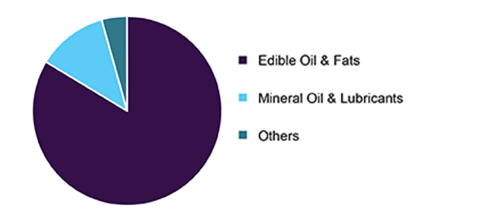
Figure 102
The Opportunities
1- Bleaching earth for refining of edible oils
About activated bentonite for edible oil refining
Oman currently imports around 3,000 tonnes of bleaching earth per year for use by edible oil manufacturing. It is believed that Oman has sufficient bentonite deposits to produce activated bleaching earth that can satisfy the domestic demand edible oil manufacturers from Oman and the gulf region.
From a national perspective, being self-sufficient in bleaching earth will contribute to improved food security. Mining and processing operations will create jobs and increase GDP whilst improving the trade balance of the country. Finally, bentonite is a very versatile raw material that can be used in a wide range of applications including pharmaceutical products, paint, detergents, geosynthetic clay liners etc.
The key challenges are that there are currently no activated bentonite mines operating within Oman, quantities and composition of the required raw materials are unknown. It is likely that substantial infrastructure related to the mining and processing operations will need to be established which takes significant periods of time. This application can help to build the business case for large scale investment in bentonite mining.
About the market for activated bleaching earth
There are two major edible oil producers in Oman:
- Areej Vegetable Oils & Derivatives SAOC – http://www.avod.om/
- Omani Vegetable Oils & Derivatives Co.(L.L.C) – http://www.omanioil.net/
Areej is one of the top 20 largest public limited companies in Oma. The company has confirmed that they currently consume around 120 tonnes of bleaching earth per month at a cost of OMR 166 per tonne. Currently, they import this product from Ashapura Group[138] (Bhuj, India).
Typical facilities for production of activated bleaching earth
The basic processing steps in the production of acid activated bleaching earth are shown in below Figure . The most technically challenging step is the activation process. Activation can be done by thermal or chemical processes. For calcium bentonite, acid activation using sulphuric or hydrochloric acid is the most widely used approach for activation.
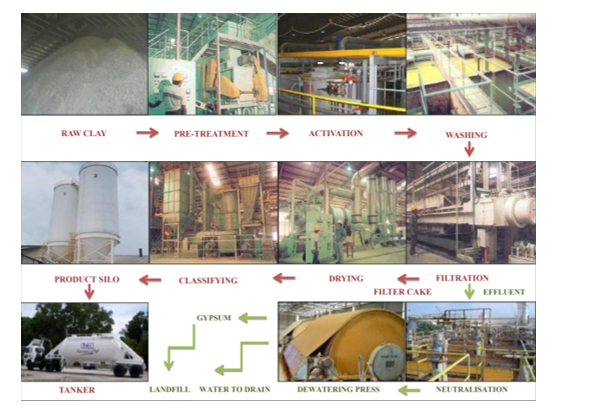
Figure 106
Canvas
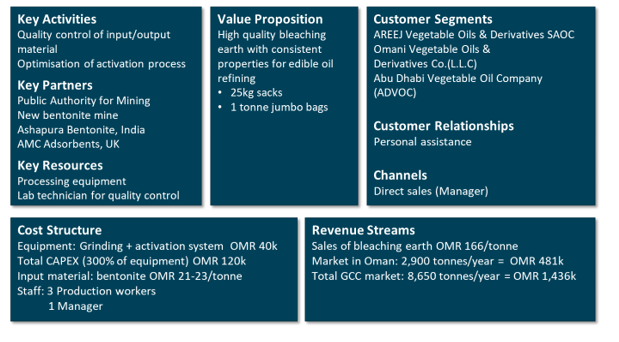
The lack of active bentonite mining in Oman presents a major challenge for this application. Although Modern Salt Industries & Trading Co LLC have a prospecting license in place, it is not clear when bentonite mining will commence. However, a roadmap to large scale bleaching earth production has been proposed that involves developing the application in five phases, as shown in below figure.
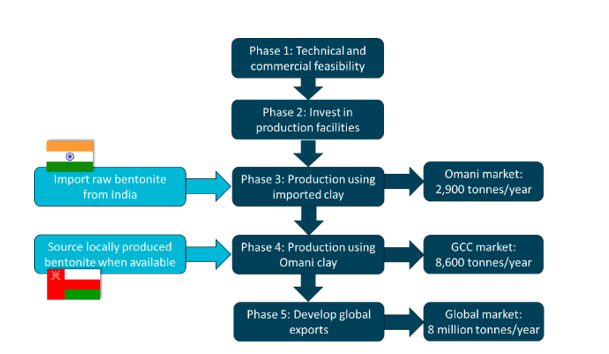
Figure 108
In Phase 1, the commercial feasibility will be assessed through financial modelling and discussions with edible oil producers in Oman. Technical analysis of the available clay resources in Oman should be performed to identify the most suitable clay deposits for this application. Lab-scale testing with samples from the most promising deposits can be performed to assess the bleaching performance of the Omani clay compared to the existing commercial product.
In Phase 2, the bleaching earth production facility is constructed. Expertise in design and operation of a bleaching earth facility will be required to ensure a well-designed facility that is efficient and has scope for future expansion.
In Phase 3, production commences using imported raw bentonite from India (assuming that locally sourced bentonite is not available at that time). The focus will initially be on the domestic market for activated bleaching earth.
Once locally sourced bentonite is available production costs should decrease due to reduced transportation costs the input clay. This should enable entry into export markets in Phase 4, starting with the wider GCC market.
In Phase 5, expansion of the production facilities should be envisaged to enable economies of scale benefits so that the company can compete with major producers in the global market.
If during Phase 1 it is found that the bentonite deposits in Oman do not offer effective bleaching performance, or if the bentonite mining activity seems unlikely to commence within the next five years, an alternative approach would be to explore the use of thermally-activated, attapulgite-based bleaching earth. An initial study of the Shuwaymiyah attapulgite deposit has confirmed that it is a large deposit (300-400 million tonnes) with 70% clay mineral content[146].
Independent of how the bleaching earth is produced, an important commercial risk for this application is that in Phase 3 sales revenues will be dependent on just two local edible oil manufacturers. Whilst the volumes of bleaching earth consumed by these companies is sufficient to support a profitable business, there is a risk in being reliant on just two customers for 100% of sales revenue.
An important technical risk is that the characteristics of bleaching earth have the potential to alter to taste, texture, and smell of the edible oil that they are used in. There will therefore need to be extensive testing by the oil producers in collaboration with the bleaching earth company to ensure that any changes to the final oil product are minimized.
Further Information
This page provides an introduction and overview of the nature of the selected opportunity. For more detailed information or to get involved with this opportunity, please contact IIC: info@iic.om