
Continuous basalt fiber production
Description of the opportunity
Continuous basalt fiber is a key input in a wide range of down-stream end products and application areas across a broad range of industries. Major end consumers of this material include construction, automotive and industrial sectors like oil and gas. It can be sold directly into these sectors, but often it is sold to intermediary manufactures in the supply chain who convert the fibers into final products. Continuous basalt fiber is most often sold as semi-finished products in the following formats:
- Roving: Used in the manufacture of basalt rebars, construction mesh or pipes and profiles
- Twisted yarn: Used in the manufacture of textiles and yarn- or textile-based engineering products
Adjustment of fiber composition, length, diameter and coating are among the key variables which can be modified for different applications and properties.
Whilst CBF products are often sold as roving or twisted yarn it is common to integrate additional production steps to widen end markets and add value. The simplest example of this is introducing a cutting step to make chopped fiber which can be sold for alternative end applications. Typically, these applications include fiber-reinforced composites that benefit from addition of discrete fibers.
It is a common strategy for companies producing CBF to place considerable effort in engaging with downstream companies to stimulate the market for new products. Therefore successful execution of this opportunity will require establishing a supply chain within which a CBF production company can identify, engage, and secure buyers for the product, ideally across multiple sectors and application areas.
Market of the opportunity
Continuous basalt fiber is a key input in a wide range of down-stream end products and application areas across a broad range of industries. Major end consumers of this material include construction, automotive and industrial sectors like oil and gas. It can be sold directly into these sectors, but often it is sold to intermediary manufactures in the supply chain who convert the fibers into final products. Continuous basalt fiber is most often sold as semi-finished products in the following formats:
- Roving: Used in the manufacture of basalt rebars, construction mesh or pipes and profiles
- Twisted yarn: Used in the manufacture of textiles and yarn- or textile-based engineering products
Adjustment of fiber composition, length, diameter and coating are among the key variables which can be modified for different applications and properties.
Whilst CBF products are often sold as roving or twisted yarn it is common to integrate additional production steps to widen end markets and add value. The simplest example of this is introducing a cutting step to make chopped fiber which can be sold for alternative end applications. Typically, these applications include fiber-reinforced composites that benefit from the addition of discrete fibers.
It is a common strategy for companies producing CBF to place considerable effort in engaging with downstream companies to stimulate the market for new products. Therefore successful execution of this opportunity will require establishing a supply chain within which a CBF production company can identify, engage and secure buyers for the product, ideally across multiple sectors and application areas.
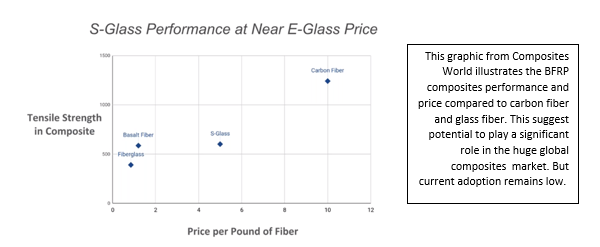
Figure 33: Comparing performance and price of BFRP composites, carbon fiber and glass fiber
Example applications include construction composites, sporting goods, automotive bodies, marine applications like boat hulls and many others. The use of basalt fiber within hybrid composites (for example basalt and carbon fiber combinations) is also seeing a significant amount of attention. However, to date the majority of applications remain exploratory or small scale.
Large manufacturers of continuous fiber like Kamenny Vek and Mafic are continuing to build relationships and alliances with companies within these end markets in order to be the suppliers of choice if and when these huge markets open up.
Identification and collaboration with downstream customers are key to market growth
It is essential for CBF manufacturers to engage with downstream companies to stimulate the market for the use of basalt fiber derived products. Initial conversations with Jeff Thompson (former head of Marketing for Mafic, US) confirmed this was the approach taken by Mafic after building their manufacture facility in the US (reported to be the world’s largest basalt fiber production plant). Jeff was responsible for managing a portfolio of downstream product opportunities in order to stimulate the market for basalt fiber in the US.
Kamenny Vek (Dubna, Russia), is another major CBF manufacturer. They place substantial resource into investigating and developing downstream applications. They collaborate with the automotive industry on exhaust system insulation and producers of heat-resistant materials for industrial applications. However, they are investigating many other long-term applications including the use in wind turbine structures.
The market opportunity is a function of overall market size, growth trends, the nature of Oman basalt deposits, industry competition and demand for the materials in local and regional markets. It is also important to consider whether production will be limited to continuous fibers or expands further into further value-added products.
SWOT analysis
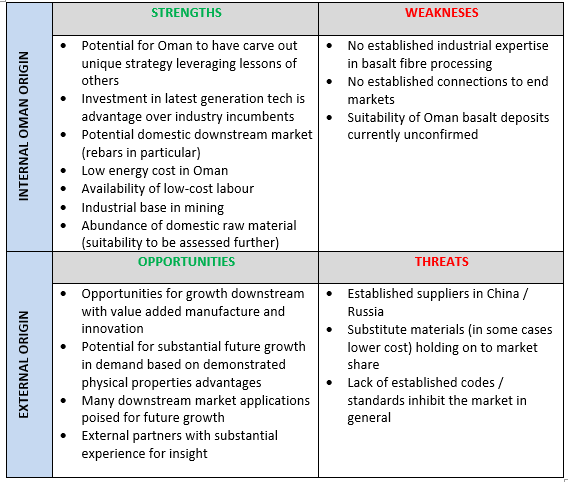
Table 11
Key technical trends
Technical trends associated with the production of continuous fibers are primarily related to two key areas:
- Bushing design: There is substantial know-how and IP associated with this area
- Sizing: This term refers to chemistries used to coat the fibers. Recent assessments suggest that the chemistries used historically have been deficient and this area has seen substantial improvements in recent years
There is also a move towards large furnaces, away from modular production facilities (utilising multiple small furnaces). According to commentary these modular furnaces produced issues of consistency which hindered the market, because it was impossible to replicate consistent products from different furnaces (despite their identical design).
Because CBF has such large number of potential downstream applications, technical trends relate the many R&D projects being conducted in university and company labs testing the performance of basalt in alternative applications. Associated with this is the work going on within CBF companies to produce properties (fiber diameter, length and consistency) to meet those applications.
Typical production facilities
The continuous basalt fiber (CBF) production process is relatively simple (Figure 34). Production can be summarized in the following steps:
- Feeding screened raw basalt material (from consistent source);
- Melting and homogenization of basalt melt;
- Forming of basalt melt through a bushing assembly (often using platinum alloy) and extraction of fiber
- Lubrication and winding on bobbins
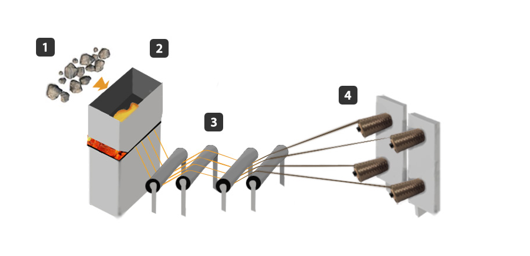
Figure 34: Production Process of CBF
Although the generic process is simple, there is substantial know-how and expertise required to ensure optimized production of a consistent product. One key variable is understanding how equipment should be designed for specific chemical composition of basalt deposits. These variables impact the parameters of the BCF production process, equipment and bushing assemblies in particular.
Production techniques have been optimized over the years and the latest know-how resides within a small number of companies with diversified experience in equipment design, development, construction and optimization.
Business Canvas
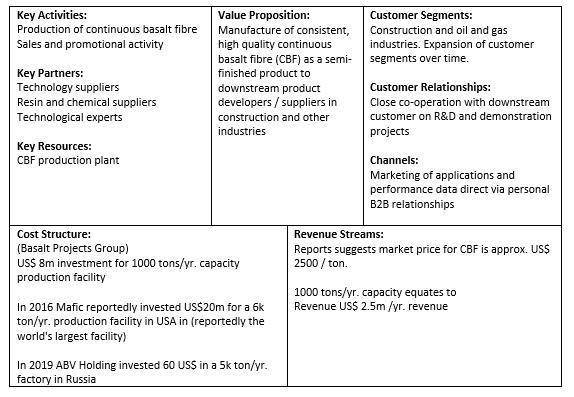
Table 12
Further Information
This page provides an introduction and overview of the nature of the selected opportunity. For more detailed information or to get involved with this opportunity, please contact Talal Al Wahaibi at the IIC: Talal.AlWahaibi@iic.om