
Background
Ground calcium carbonate (GCC) is a finely ground, high-purity limestone product, produced from naturally occurring high purity calcite ores where calcium carbonate is the major component. Its production requires only washing, crushing, and grinding, with no chemical reactions needed. It is widely used as a filler or as a source of calcium across a very wide range of industries, including food and pharmaceuticals, paper and pulp, plastics, paints and coatings, agriculture and animal feed, and rubber.
Production of GCC1
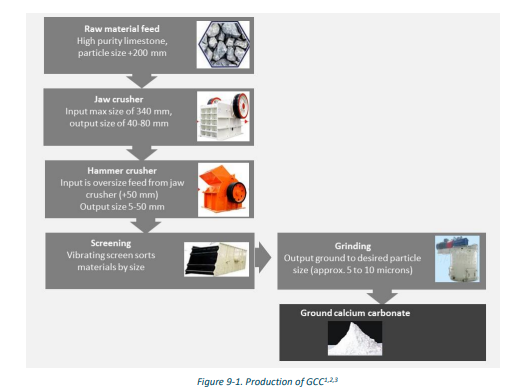
Following limestone mining, GCC production requires only crushing, screening, and grinding (Figure9-1). Crushing is in two stages (jaw crusher followed by transfer on conveyer belt to hammer crusher) to reduce the size of feed for input to the grinding mill. Grinding occurs in a mill that uses a system of rings with rotating grinding rollers to create a powder. The mill also contains classifier, blower, screw conveyer, discharge valve, offline pulse filter, and an air compressor.
Production costs
A 2019 study of the potential of the limestone industry in Jamaica concluded that an investment in developing GCC could be financially feasible for a total production of 30,000 tonnes per annum4. This analysis examined two scenarios: a standalone (start-up) basis, and an incremental basis, i.e. adding GCC production on to an existing limestone mining operation. On an indicative basis, the internal rate of return was calculated to range from 33.8% to 49.55, and net present value (NPV) to range from $11.8 million (for standalone basis) to $13.0 million (for incremental basis).
The case study estimates a total capital expenditure of $3.41 million to set up a standalone GCC plant,and $2.81 million to add GCC production to an existing operation. Some costs in this case study,notably equipment costs, laboratory costs, and infrastructure costs, are based on industry standard figures and provide a reasonable starting point for estimated costs in Oman. However, note that cost of land, power, and transportation equipment are based on Jamaica, and may differ significantly in Oman. The notes in Figure 9-2 indicate the source of the estimates and comment on expected similarities or differences in Oman.
The case study calculates the following operating expenses:
For a standalone GCC production unit:
• Total operating expenses $907,190 (year 1) rising annually to $981,972 (year 5)
• Gross profit margin: 92% (average over the first 5 years)
• Net profit margin: 34% (average over the first 5 years)
For addition of GCC to an existing production unit:
• Total operating expenses $895,010 (year 1) rising annually to $968,788 (year 5)
• Gross profit margin: 92% (average over the first 5 years)
• Net profit margin: 37% (average over the first 5 years)
Note that these operating costs and profits are calculated for Jamaica and are likely to differ in Oman.
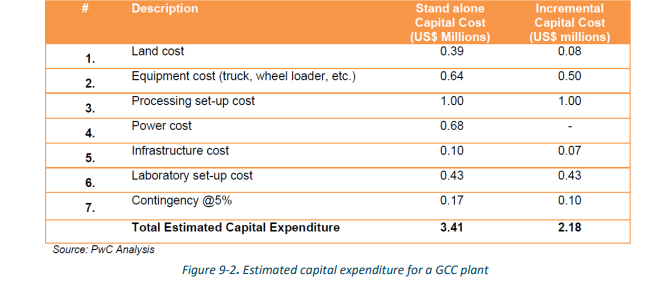
Figure notes:
Land: Based on cost per hectare of land in Jamaica (estimated at $30,000 per hectare). Estimated that one hectare of additional land is needed in addition to an existing quarry for production of GCC, including plant facility, workshop, storage area, waste disposal, worker camps, etc.
Equipment: Calculated based on cost of truck and wheel loader sourced from the USA with contingencies added to cover for transportation and duties for Jamaica.
Processing set-up: Includes crushing, screening, grinding, and packaging systems with supporting plant equipment, sourced from China (because of lower procurement costs) – this aspect is likely to 16 be very similar for Oman. However, the figures include transportation and duties that were estimated for Jamaica.
Power: Assumes power provided from grid and that a grid connection is already established.
Infrastructure: Includes covering shed, laboratory facilities, etc. and is based on typical industry standard costs for setting up value-added plants, therefore likely to be similar in Oman.
Laboratory set-up: Estimated for testing basic mineral content and size, for basic grade testing; estimate based on industry standard cost for basic laboratory testing equipment so likely to be similar in Oman.
Contingency: A 5% contingency is added to the total capital cost to cover project threats or uncertainties.
Market demand for GCC product
GCC is used as a filler in a wide range of applications. The total global demand for fillers is estimated to be 75 million tonnes by 2024, which includes ground calcium carbonate (GCC), precipitated calcium carbonate (PCC), kaolin, talc, carbon black, and other fillers1.
GCC is the most widely used filler on the global market and is estimated to occupy a market share of 34% of the market for fillers worldwide9. The global market for GCC is estimated to be worth $22.6 billion by 20262. Different reports cite different growth rates, with one estimate of an annual increase of 2.5% by 20249, and a second estimate of annual increase of 5.4% by 20263.
Geographically, by far the largest world consumer is Asia, led by China; the USA and Western Europe are also major consumers, and the Middle East/Africa region accounts for only a small part of the market. For example, one market report estimates that the calcium carbonate market in the Middle East and Africa will grow from an estimated $1,281,43 million in 2021 to $1,666.05 million by 2028, at a CAGR of 3.8%Error!Bookmark not defined. Note that this estimate includes all calcium carbonate,i.e. precipitated calcium carbonate (PCC) as well as GCC, as estimates of market size for GCC in the Middle East are not readily available.
Demand for GCC by industry sector
Gaining a detailed understanding of the market opportunity for GCC in different industry sectors is difficult because most market reports cover the use of calcium carbonate overall, including both ground and precipitated forms (GCC and PCC), without distinguishing between them. However, one source indicates that the largest consumer of GCC is plastics, the second largest is paints and coatings,and the third largest is paperError! Bookmark not defined.. In contrast, PCC is most widely used in production of paper, with second largest application as paints and coatings.
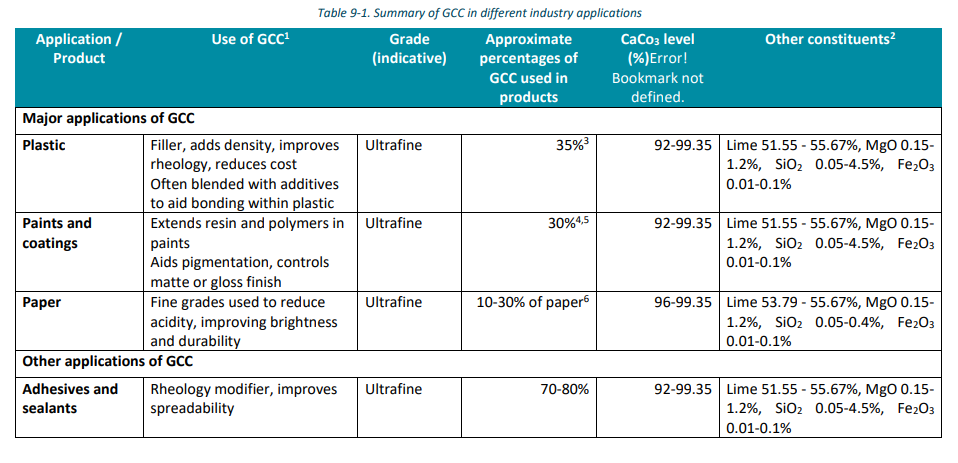
Table 9-1 summarizes the use of GCC in downstream applications. The following sections discuss the opportunities in Oman for the three largest applications of GCC, and a final section to discuss if any more minor applications of GCC constitute a significant opportunity for Oman.
Plastics
Four types of polymer resin (polypropylene, polyamides, thermoplastic polymers, and polyvinylchloride) account for 90% of the market of mineral fillers in plastics1. GCC filler is used mainly in polypropylene and polyvinyl chloride and is one of the most important, versatile, and widely used fillers for polypropylene in terms of weight. It provides higher stiffness and impact resistance as well as economic benefits.
Global demand for polypropylene is estimated at 83.7 million metric tonnes, with 4.5% growth between 2016 and 20212. The polymer industry in the Gulf Corporation Council region is expected to reach 34.5 million tonnes by 2022, supporting further downstream development while growing at a CAGR of 3%3. A major drive of the use of polypropylene is the automotive industry.
Oman Oil Refineries and Petroleum Industries Company (Orpic) runs a polypropylene production plant in Sohar which forms part of the government’s vision to develop the chemical manufacturing industry and produces 340,000 tons per year of polypropylene4,5. Products from the plant are exported under the brand name Luban to more than 63 countries, including the GCC states, India, Pakistan, Sri Lanka,Bangladesh, China, Vietnam, Peru, South Korea, Myanmar, the Philippines, and South Africa23. Luban is used in the production of plastic chairs, tables, carpets, packing materials, ropes, caps, packing straps, and other electrical and home appliances. Orpic also has commissioned the Liwa Plastics Industries Complex (LPIC), which aims to enhance production of polypropylene by 640,000 tonnes per year, as well as 440,000 tonnes of LLDPE and 440,000 tonnes of HDPE. Orpic sees potential for Oman to become a global hub for polymer-based applications in industries such as automobile, healthcare,packaging, and textiles. This ambition indicates a growing market for GCC as a plastic filler in Oman.
Paints and coatings
GCC is used to extend the resins and polymers used in paint and to control a matt or gloss finish. As an extender, it can comprise as much as 30% by weight in paint6. Advantages include its whiteness, opacity, weather resistance, inertness, low abrasiveness, and pH stabilizing effect.
Mordor Intelligence reports that the Oman paints and coatings market is highly consolidated with major players dominating the market, including Jotun AS, AkzoNobel, Asian Paints, Khimji Paints, National Paints Factories Co. Ltd, etc.7. The market is predicted to grow at a CAGR of 4% between 2016 and 2026. In Oman, the biggest single paint category is acrylic paints, and the largest end-application is architectural applications, where paint provides both decorative and weatherproofing properties.The sector likely benefitted from allocation by the government of 3.7 billion Omani Rial for infrastructure, development, industrial, and services projects in 2019. A total of 2410 active construction projects in Oman with combined value exceeding $190 billion suggests a strong and growing market for paints and coatings in Oman.
Paper
Paper constitutes a large, and according to some market reports, the single largest market application for calcium carbonate1. However, market data do not distinguish between PCC and GCC. Both forms are used as fillers in paper but PCC is broadly preferred over GCC because it provides better gloss and opacity properties and is a synthetic rather than a natural product, so its properties are more closely controlled2. Where GCC is used as a paper filler, the most widely used classes are fine ground (70% <2 m) and ultrafine ground (90% < 2 m)3. However, Oman’s paper industry appears to be small scale(for example, Oman Royal Paper states that it is the first paper mill in Oman, and the only supplier of craft papers in Oman4). Taken together, these observations suggest that the paper industry does not present a short-term opportunity if Oman were to increase its GCC production. Section 10.6.3 discusses some ideas that may help to establish a paper industry in Oman in the longer term, but even in such an eventuality, the main opportunity is likely to be for PCC rather than for GCC.
Other applications
GCC is used in a very wide range of industry applications and this section discusses which of these may offer an opportunity for Oman.
Adhesives and sealants
GCC is widely used as a filler and for control of viscosity in adhesives and sealants. It can comprise upto 80% of the formulation of ceramic adhesives5. Its mechanical properties depend on the particle size used. There is limited production of adhesives in Oman; for example, Sadolin Paints manufactures adhesives and lacquers as well as paints6; however, there is no indication of a major industry or of upcoming developments in this area and this application seems unlikely to offer a significant opportunity.
Agriculture
GCC is used in fertilizer conditioners and fillers and to control soil acidity. There is an industry for agricultural fertilizers in Oman with major players including ORPIC, the Oman India Fertilizer Company (OMIFCO), Suhail Bahwan Group, Oman Formaldehyde Chemical Company (OFCC), Oman Methanol Company (OMC), and Salalah Methanol Company (SMC)Error! Bookmark not defined.. However, none of these appears to produce calcium carbonate. Participants at the limestone workshop on 7th July 2021 commented that Oman’s current approach to agriculture (small family farms and mostly not adopting intensive western agricultural practices) suggests that agriculture does not present a significant opportunity for GCC product.
Animal and pet feed
GCC is added at low levels (approx. 1%18) to animal and pet feed to optimize nutritional calcium. There is an animal feed industry in Oman including companies such as Omani National Livestock Development Company and Dhofar Cattle Feed Company. The sector also appears to be a focus of development. The A’Namaa Project in Ibri aims to boost poultry meat production capacity by 60,000 metric tonnes per annum1. The project includes a warehouse, hatcheries, a 50 tonne per hour feed mill, a processing plant and water treatment plant, and a slaughterhouse with capacity for 200,000 birds per day. Regarding red meat, the Al Bashayer Meat Company was formed in 2016 and aims to become the preferred meat brand in Oman and the GCC region. It plans to operate a fully integrated red meat project that includes providing feed to optimise animal growth. These examples suggest animal feed may provide an opportunity for use of GCC product, though this is likely to be small scale because of the low level of GCC used.
Food, pharmaceuticals, and cosmetics
Food, pharmaceuticals, and cosmetics all require high-grade GCC product, generally referred to as pharmaceutical grade. In the pharmaceutical industry, high-purity GCC is used in the manufacture of various products such as milk of magnesia, calcium supplements, antacids, and as an excipient in various pills. As of 2018, Oman imported more than 93% of its medications, laboratory, and surgical equipment. However, Oman is building an OR 140 million pharmaceutical plant at Salalah Free Zone, which aims to produce more than 100 types of drug, and the company Oman Pharmaceutical Products, part of Al Bahja Group, is also located at Salalah and can produce up to 2.7 billion tablets and capsules, 26 million topical preparations, and 19.5 million oral liquid doses per year. These figures suggest a possible market for high-purity GCC in the pharmaceutical sector. If such high-purity GCC is produced,it could also be used in the food and cosmetics sectors.
Rubber and elastomers
The most widely used fillers in rubber are carbon black and silica-based products. A major application of GCC in rubber is in latex carpet backing, where it is blended in quantities as high as 35% by weight with latex to form an economical adhesive backing1.
Business canvas: GCC
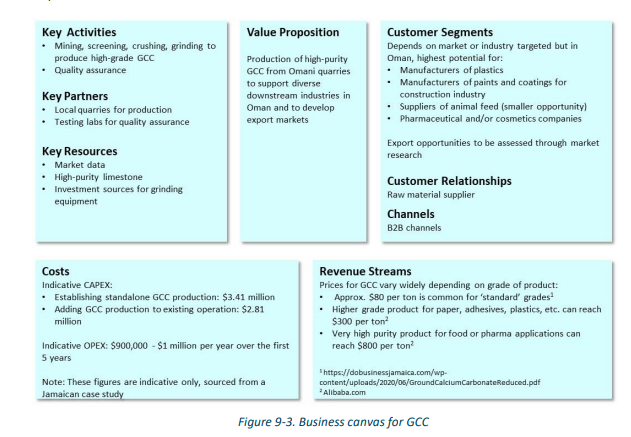
Figure 9-3 summarises the business opportunity for production of GCC from Omani limestone deposits.
Next steps
Oman already produces some GCC but has scope to expand production of higher value GCC. In outline, the steps needed are as follows:
• Use existing data to identify locations where the limestone is of sufficiently high purity to be used for GCC production (Section 8.2). Further characterization work may be required, especially by individual quarries, so that a detailed plan can be made.
• In parallel, commission market research to decide which industry sector(s) to target and hence the purity of GCC to be produced.
• Once a downstream application is decided and suitable sources are identified, work with quarry owners to support them in setting up the processing steps necessary to generate GCC of the required quality.