
Background
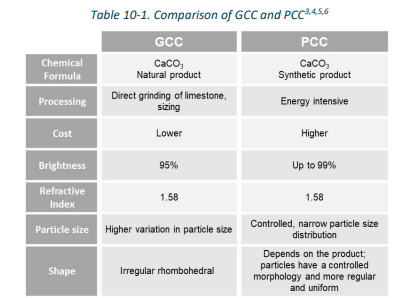
Precipitated calcium carbonate (PCC) is a synthetic compound made by hydrating high-calcium quicklime and reacting the resulting slurry with CO2. The product is very white and typically has a narrow and uniform particle size distribution. As a synthetic product, its particle size, shape, and any coatings can be controlled and fine-tuned as needed for specific applications and it can therefore provide more sophisticated functionality than GCC1. For example it can be made with small particle sizes, high surface areas, high oil absorptions, and/or with powder bulk densities ranging from ultralow to super-high2. Its purity is higher than GCC, reaching up to 99.999%, as impurities are removed during production, and grain size can be controlled in a range from submicron to more than 10 microns. Table 10-1 compares the properties of GCC and PCC.
Limestone feedstock for PCC
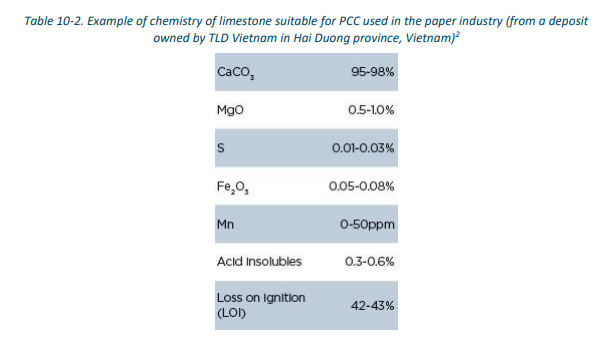
High quality limestone is required for PCC production, with low levels of manganese and iron impurities because these elements have detrimental effects on the brightness of the product. Table 10-2 shows the typical chemistry of starting limestone feedstock for PCC for paper production7. Note that the recommended chemistry varies in different sources: for example, another publication suggests that the levels of iron oxide (as Fe) should be less than 0.01% and manganese (Mg) less than 0.005%1.
Production of PCC
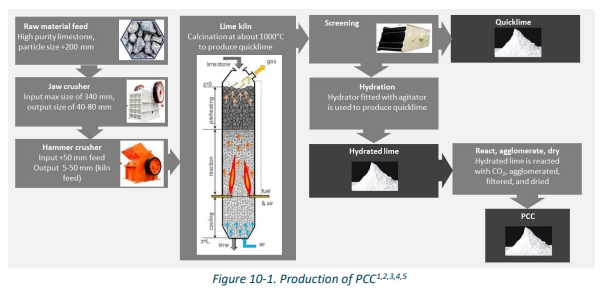
Figure 10-1 shows a summary of the PCC production process, known as the milk of lime process. Crushing is in two stages (jaw crusher followed by transfer on conveyer belt to hammer crusher) to reduce the size of feed for input to the lime kiln. In the lime kiln, limestone is calcined at about 1000°C to produce quicklime. Product from the lime kiln is hydrated, then reacted with CO2, agglomerated, and dried to produce PCC. The drying is a major part of the operation, and typically involves filtering on a press to make a white cake with approximately 10% humidity, which is then dried using compressed air. The particle shape and particle size distribution of the PCC product depends on the precipitation conditions, such as concentration, temperature and temperature change during precipitation, agitation energy, pH, and other factors3.
A PCC plant needs approximately 10m3 of water for each ton of PCC produced. However, more than 90% of this water is recyclable and about 30% can be reused within the PCC plant. An interviewee suggested that the remaining of 60% recyclable water could be used for other adjacent limestone industry processes, such as in a hydrated lime plant or an adjacent Autoclave Aerated Concrete (AAC) plant (discussed further in Section 11.4)6. Alternatively, with further purification it could be used for industrial or farming water.
Production costs
German PCC production plant manufacturer Blitzco suggested that establishing a PCC plant in Oman,which would produce approximately 24,000 ton of PCC per year of between 1 and 2 microns (suitable for rubber, plastics, paint, etc.) would cost approximately 10 million Euros. This figure includes all the machinery required, construction and installation. Production of higher specification medium sized PCC in a narrower size range of 1-1.5 micron would produce approximately 16,000 ton/year. A nanoPCC (0.08-0.8 micron) production plant with more complex operations would produce 9,000 ton/year. Blitzco stated that operating costs are highly dependent on gas, electricity and the cost of the local workforce, and would need to be estimated in a detailed feasibility study.
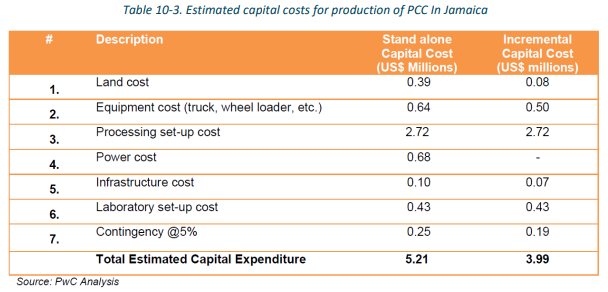
Separately, a 2019 study of the potential of the limestone industry in Jamaica concluded that an investment in developing PCC could be financially feasible for a total production of 30,000 tonnes per annum. This analysis examined two scenarios: a standalone (start-up) basis, and an incremental basis,i.e. adding PCC production on to an existing operation. On an indicative basis, the internal rate of return was calculated to range from 25.6% to 32.3%, and net present value (NPV) to range from $12.1 million (for standalone basis) to $13.2 million (for incremental basis).
The case study estimates a total capital expenditure of $5.21 million to set up a standalone PCC plant, and $3.99 million to add PCC production to an existing operation. Some costs, notably equipment costs, laboratory costs, and infrastructure costs, are based on industry standard figures and provide a reasonable starting point for estimated costs in Oman. However, cost of land, power, and cost of transporting equipment are based on Jamaica, and may differ significantly in Oman. The notes in Table 10-3 indicate the source of the estimates and comment on expected similarities or differences in Oman. Note that the case study also includes detailed estimates of operating expenditure, but these are not included in this report as they are likely to vary substantially in different geographic regions.
Notes:
Land: Based on cost per hectare of land in Jamaica (estimated at $30,000 per hectare). Estimated that one hectare of additional land is needed in addition to an existing quarry for production of PCC, including plant facility, workshop, storage area, waste disposal, worker camps, etc.
Equipment: Calculated based on cost of truck and wheel loader sourced from the USA with contingencies added to cover for transportation and duties for Jamaica.
Processing set-up: Includes crushing, screening, grinding, and packaging systems, lime kiln, and hydration and carbonation unit, with supporting plant equipment, sourced from China (because of lower procurement costs) – this aspect is likely to be very similar for Oman. However, the figures include transportation and duties that were estimated for Jamaica.
Power: Assumes power provided from grid and that a grid connection is already established.
Infrastructure: Includes covering shed, laboratory facilities, etc. and is based on typical industry standard costs for setting up value-added plants, therefore likely to be similar in Oman.
Laboratory set-up: Estimated for testing basic mineral content and size, for basic grade testing; estimate based on industry standard cost for basic laboratory testing equipment so likely to be similar in Oman.
Contingency: A 5% contingency is added to the total capital cost to cover project threats or uncertainties.
Applications of PCC
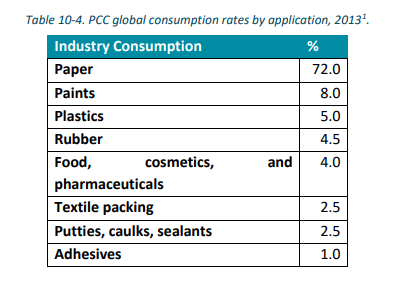
PCC is highly versatile. Its high purity, well-ordered particle size, and morphology makes it highly suitable as a white filler material with many applications. It is most widely used in production of paper, with the second largest application in paints and coatings. It is also used as a filler in rubbers, plastics, drugs, etc. and as a nutritional supplement (Table 10-4).
Paper
PCC is used in paper as both a filler and in coatings to enhance brightness, colour, smoothness, and bulk, replacing more expensive paper pulp. It usually comprises between 10%-30% by weight in paper2. Approximately three-quarters of worldwide PCC production is used for this purpose3.
Paints and inks
PCC is used as a pigment extender to partially replace more costly titanium dioxide (TiO2) dosages in paints and to provide opacity and brightness. It also increases porosity and improves processability characteristics, gloss and quality. PCC typically comprises between 10 and 20% by weight in paints1.
Plastics and rubber
PCC is used as a filler in various types of plastic such as polyethylene (PE), polypropylene (PP), and polyvinyl chloride (PVC). Calcium carbonate fillers dominate the market for PP and PVC2. The strict process control means all aspects of particle size and morphology are controlled to exacting specifications3. In plastics, PCC is a highly effective impact modifier, rheology control agent and filler. PCC improves the strength and flexibility of rubber products. It also imparts whiteness and quality and for lower cost. It is usually used at a loading of between 5% and 40% in plastics and rubbers 4.
Note that PCC used as fillers in rubbers and plastics is often treated with surface active agents such as stearic acid to improve processability, dispersibility, dispensability, stability, wettability, etc5. This helps the final product to maintain its compression stability, and in turn enhances other mechanical properties, such as tensile strength, ultimate elongation and hardness.
Food and pharmaceuticals
Calcium carbonates, including PCC, are non-toxic, so provided the PCC meets certain purity requirements, it can be used as a direct food additive, as a pharmaceutical or as an indirect additive in paper products that come in contact with food. Many medicines contain PCC as the base material of pills, or for bulking of liquid medicines, ointments or creams.
Technology trend: Nano-PCC
Nano-PCC, also known as ultrafine PCC, has an average particle diameter of less than 1 micron. It has more limited, specialised applications compared to standard PCC and its main markets are in inks, paints and some medicines and as an additive to cosmetics6. Previously, use of nano-PCC as a filler in rubber and plastics was limited by issues with mechanical strength at higher loading, but innovation and technical advances are overcoming this limitation. When used as a functional filler it can impart unique properties including high porosity, high surface area to volume ratio, and exceptional mechanical properties. The use of nano calcium carbonate particles in chemical, biological and industrial applications is increasing as researchers across the globe discover more of their properties and novel/improved applications. Nano-PCC is expected to have a potential market as a substitute for expensive additives such as carbon black, white carbon black and titanium dioxide1 and has potential for use in drug delivery systems2.
Nano-PCC is sold at much higher prices than standard PCC, but its markets are more limited in volume. Nano- PCC can be produced in a standard PCC plant with specific modifications including additional
special machinery and devices.
If Oman commissions a PCC plant, standard PCC production is recommended as a first step. Nano-PCC production could be considered subsequently depending upon the market and other conditions.
Commercial feasibility of establishing a PCC plant
PCC plants are usually established to serve specific downstream industries, often but not always as satellite plants to paper mills. This section considers downstream industries that may benefit from a supply of PCC in Oman.
PCC plus hydrated lime plant
As PCC plants require hydrated lime and carbon dioxide and water, they are often located adjacent to lime production plants. Where a PCC plant is not associated with a lime plant, the CO2 it requires has to be obtained from other sources.
For example, in Bad Ischl, Austria, a lime plant has been in operation since around the year 1900, and a PCC plant has been commissioned, due for completion this year. The plant will supply a wide range of industries across Europe, such as paint and varnish, paper, plastics, adhesives and sealants3.
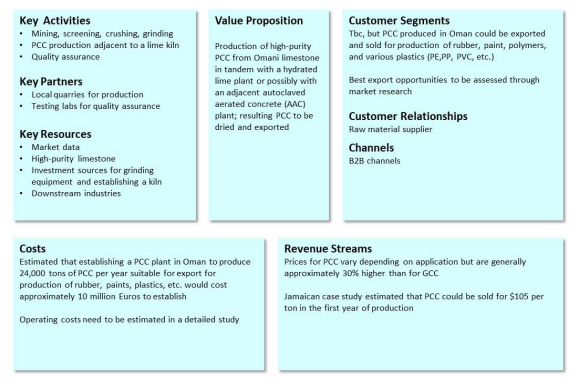
PCC plant equipment manufacturer Blitzco suggested that in Oman, a 24,000 ton per year PCC plant could be installed with a hydrated lime plant, ideally close to a source of limestone. 100 ton per day of lime would go to the PCC plant, and a second 100 ton per day would be used for hydrated lime production, which would be sold as a separate product. Recycled water from the PCC drying process would be used for production of hydrated lime.
PCC plant plus autoclaved aerated concrete plant
A second suggestion for Oman is to commission a PCC plant with an adjacent autoclaved aerated concrete (AAC) plant, which would complement the plant and reuse the recycled water from the PCC drying process. AAC bricks are an ultra-light concrete masonry product (85% air), produced from sand and/or fly ash, quick lime, gypsum/anhydrite, cement, aluminium, and water1. This could be highly feasible for Oman if sand of suitable quality is available nearby; the purity of silica needs to be more than 75% and no salt should be present.
PCC plant as a satellite to a paper plant
As PCC is needed for paper production, either paper manufacturers establish a satellite PCC plant next to the paper plant, or an independent PCC plant can supply several paper factories in the same region2. In the short-term, neither is feasible for Oman, as there is no paper plant in operation in the country (Oman does have several paper recycling plants, but PCC is not used for paper recycling). Export of PCC for use in paper plants worldwide is not considered viable because the PCC has to be dried before export, which is a very big and costly part of the operation. Paper plants can use PCC in a wet slurry directly from an adjacent plant without the need to dry it first. In the absence of a paper industry, a PCC plant in Oman could be established and export dry PCC product for other applications including for production of rubber, paint, polymer, PE, PVC, PP etc. According to Trademap.org the value of world exports of calcium carbonate (GCC + PCC) in 2020 was close to 660 million USD3 .
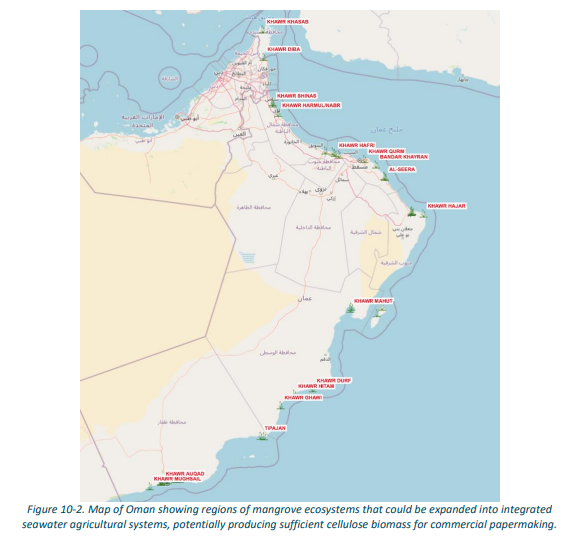
The lack of papermaking in Oman is unsurprising given the lack of forestry to produce wood pulp as a source of cellulose. However, in the medium to long term, Oman could produce biomass suitable for papermaking from other sources. One such possibility is mangrove agroforestry. The Omani coastline was once heavily populated with mangroves, and there are efforts by the environment authority to re-establish these ecosystems. The Ministry of Agriculture and Fisheries is also considering integrating mangrove agroforestry with aquaculture to create an integrated seawater agricultural system4. Research has found that mangroves can be used to provide pulp for production of newsprint,wrapping, writing, and printing papers5,6. Establishing a papermaking industry could reinforce the financial case and in turn the commercially viable demand for PCC. Such a combination of projects would be in line with investor priorities seeking to support environmentally sustainable opportunities and paper buyers who may be interested in sourcing paper from regenerative mangrove-based systems.
Another possibility in Oman is to produce cellulose for papermaking from agave. Agave has the advantage of being fast growing and needing little or no irrigation and has shown to be suitable for papermaking, although more research is needed to commercialise the process1. Research into papermaking from agave has focused to date on the use of waste streams from the production of tequila for which the species is best known. However, Mexico is investing significantly in agave agroforestry for purposes other than syrups and tequila, such as the Billion Agave Project2, and the possibilities for downstream industries are being evaluated.
The production of PCC for papermaking could therefore be considered in conjunction with the potential development of these agricultural systems over a time horizon of 10+ years.
Business canvas
Next steps
To establish a PCC plant in Oman, the following steps are recommended:
• Conduct a detailed market study to understand the opportunity in downstream export markets.
• Conduct a detailed economic feasibility study.
• In parallel, conduct detailed characterization studies of Omani limestone to identify suitable limestone resources
• Establish optimum location for PCC plant based on knowledge of downstream industry and proximity to limestone resources.
• Construct a business plan and seek investment