
Background
Concrete is a complete building material comprising cement, aggregates, water, and various additives depending on its use. It can be used to build foundations for walls and other masonry structures. Mortar comprises cement, sand, and water, less strong than concrete and usually used for its adhesive properties such as putting down paving flags. When using concrete or mortar, the different components must be measured (proportions depending on application), mixed either manually or in a cement mixer, creating a cone-like shape with a central crater, and water added. Once ready, the concrete or mortar must be used promptly and all tools cleaned before the concrete hardens.
The most common type of cement used in concrete is Ordinary Portland Cement (OPC), made from the calcination of limestone (calcium carbonate) and silico-aluminous material, at a very high temperatures of about 1450-1500°C, as follows:
5CaCO3 + 2SiO2 à (3CaO,SiO2) + (2CaO,SiO2) + 5CO2
Both the high heat needed and the chemical process itself mean that the cement industry makes a strong contribution to greenhouse gases. Cement production accounts for about 7% of global carbon emissions and improving the environmental footprint of cement is therefore a priority.
Premix concrete products are dry, ready-to-use, bagged concrete or mortars, including sand, gravel plus cement, and performance admixtures. These formulated products are easy to use and avoid the need to buy and mix multiple ingredients, requiring only the addition of water before pouring the concrete1. Specialist premix products have been developed that have a lower carbon footprint than OPC.
Premixes are mostly used for smaller structural applications, sold in bags from 20 to 50 kg. They are fine-tuned for specific applications, such as concrete for structural applications, plasters, and mortars for brickwork, screed (base layer for flooring). The price of premix concretes depends on their application, for example, 20 kg of multi-purpose ready-to-use concrete is £8.09 in the UK, whereas 25 kg of non-shrink cement grout costs £33.00.
Advantages of premix concrete products
Premixes offer performance, economic, and environmental benefits:
Performance benefits
Quality and consistency: Manual mixing of concrete can lead to variability in proportions of ingredients between batches, which can lead to variable quality and performance, affecting key properties such as compressive strength, workability, proportioning of ingredients, water-cement ratio, and slump. Using premixes reduces this variability and reduces risks to the project.
Convenience: Using premixes simplifies logistics (fewer ingredient suppliers, delivery times, reduced storage space needed for basic ingredients, etc.) and eliminates the need for calculations to optimise proportioning of concrete ingredients.
Versatility: The small size of premix bags, the wide range of products, and the ease of use provides greater versatility than with manual mixing.
Specialist mixes: Premixes can be tailored, including addition of nanomaterial with many additional mechanical and environmental benefits, which would not be possible to reliably handle, mix and use on a small scale in any other way.
Economic and environmental benefits
Efficiency: Removing the manual measuring and mixing of each ingredient greatly reduces manual labour time and hence capital investment. Using premixes allows concreting at a rate of 30-45 cubic meter per hour compared to 15-20 cubic meter per hour using manual mixing of concrete.
Reduced life-cycle costs: The controlled nature of premixes provides a guarantee of structural durability, which leads to lower servicing costs that might otherwise be incurred if the concrete does not meet required standards.
Environmental benefits: Premixes are made in a controlled environment where dust, noise and any other hazards are eliminated reliably. In contrast, manual mixing of concrete often creates environmental hazards. Some premixes, including geopolymer cements, are designed to offer environmental benefits over cement (Sections 0 and 0).
Reduced waste: Using premixes reduces cement consumption by 10-12%, due to better handling, efficient measuring and mixing, and reduced human error, with concomitant economic and environmental benefits.
Pre-mix market
Global markets
The global market for premix concrete is expected to rapidly expand over the following years. The global market size, calculated to be 633.4 billion in 2019, is projected to reach USD 1,227.2 billion by 2027, exhibiting a CAGR of 8.7% during the forecast period.
The major markets for premixes are rapidly developing countries such as South Korea, India, China, and Mexico, due to the growth of construction in these markets. While all construction markets have been affected by the pandemic, the environmental credentials of premixes mean that these markets are expected to recover rapidly.
The MENA region and Omani market
Countries in the MENA/GCC region are currently undergoing rapid urbanisation, so demand for premixes with superior construction properties and time-saving benefits is likely to grow across the region. A major region for premix manufacturing in the region is India.
Given the expected growth in the Omani construction industry, Oman is likely to have strong demand for premixes. For example, the Oman 2040 vision includes an aim of supporting tourism, including construction of 80,000 rooms for accommodation. Premixes can provide time savings and other benefits that will help to achieve this mass construction within a short timeline. Many Omani companies already offer premixes and the major Omani manufacturers are shown in Table 12 1. Local demand for premix products in Oman is likely to grow to 2040.
Table 12 1. Omani companies offering premix products.
| Company | Description |
|
Al Tasmin Group https://www.altasnimgroup.com/contact-us/ |
A large construction company offering premix materials for civil construction, the oil and gas industry and other sectors.
|
|
OGR Green Concrete / Oman Green Ready Mix LLC http://www.omanmix.com/index.html
|
Offers concrete production and delivery service with onsite laboratory and two batching plants. Produces durable concrete, self-compacting concrete, high strength concrete, light weight concrete, lean concrete and insulated concrete using innovative energy saving concrete cooling technology. Partners with the German University of Technology (GU-Tech) in Halban and the Ministry of Education for knowledge transfer and provides internships for Omani students. |
|
OGR Galfar Engineering and Contracting / Galfar Aspire Readymix https://galfar.com/oman/galfar/ |
A large construction company with turnover of $1 billion. Recent projects include the water network, Salalah Airport and Muscat Expressway. Offers high strength, lightweight, coloured, precast, engineering, fibre reinforced and 3D printing concretes.
|
|
Oriental Group – Oriental Ready-Mix LLC https://www.orientalgroup.om
|
A construction company offering compressed blocks and custom concrete solutions and recipes. |
|
ReadyMix Muscat & Premix LLC http://readymixmuscat.com
|
A large concrete and premix focused company with 13 plants and 12 locations in Oman. Offers many brands and types of concrete, including but not limited to delayed setting, polymer filled, chemical resistant and watertight concretes, as well as spray mortars. |
Technical trends
Additives in premixes
Additives can be used in premixes to improve the function of the product. Although specialist premixes (admixtures) are often expensive, the benefits outweigh the costs for many industries. Additives used in concretes are often known as supplementary cementing materials (SCMs).
Nanomaterials, defined as material with structures of size range from 1 to 100 nm, are regularly used as additives in cement. Addition of nanomaterials can improve the compressive, tensile, and flexural strength of cement-based materials, as well as their water absorption and workability, and enhance the performance and lifecycle of concrete infrastructures. As nanomaterials increase the strength and durability of cement, their use can reduce the overall carbon footprint of construction (less material required and/or lasts for longer before replacement). Industry commentators predict that by 2025, over 50% of building materials may contain nanomaterials to provide lightweight, strength, and energy efficient benefits.
The nanomaterials of direct interest to the limestone and silica industries are CaCO3 and nano-silica (others are nano-alumina (nano-Al2O3), nano-ferric oxide (nano-Fe2O3), nano-titanium oxide (nano-TiO2), carbon nanotubes (CNTs), graphene and graphene oxide). Incorporation of CaCO3 nanoparticles (50 nm to 120 nm) into Ordinary Portland Cement (OPC) accelerates hydration, meaning that the cement will harden in less time. CaCO3 nanoparticles are also often mixed with fillers, such as fly ash, to compensate for the hardness that fillers often introduce into cement. Nano-silica is added to cementitious materials to reduce the calcium-silicate-hydrate (C-S-H) reaction caused by leaching of calcium into the water; the material blocks water diffusion, improving the cement’s durability workability and mechanical properties. An example is TamCem NanoSilica admixture, which is a pozzolanic alternative to traditional cementitious replacements for durable concrete, used in wet mix sprayed concrete processes for tunnelling and mining applications to provide sulphate resistance equivalent to typical microsilica (silica fume) at a much-reduced dose.
Approaches to reducing carbon footprint of construction
Premixes can be used to reduce carbon footprint during construction either by lowering the clinker content of cement or by reducing processing and lifecycle emissions.
Lowering the clinker content
Clinker, the backbone of cement production, is a mix of limestone and minerals transformed by heating in a kiln at 1450°C. Carbon dioxide is emitted from the conversion process (process emissions) as well as from the heat needed to start and sustain the reaction (combustion emissions). The clinker is finely ground and mixed with gypsum and often with alternative raw materials to make cement.
Replacing clinker with alternatives can potentially reduce the carbon footprint of cement. One alternative is a combination of limestone and calcined clay called LC3. Using LC3 can reduce CO2 emissions by up to 40%. LC3 is made from limestone and low-cost, low-grade clays and its use does not require capital-intensive modifications to existing cement plants. In 2021, Cementir will begin distributing FUTURECEM, an LC3 cement with 35% of clinker replaced by limestone and calcined clay, and a carbon footprint up to 30% lower than standard cement. FUTURECEM maintains the same qualities as pure Portland cement, unlike some LC3 products that reduce the strength of the cement. Portland Limestone Cement (PLC) offers a product that contains between 5 and 15% limestone, which can be used interchangeably with most Portland cement applications, similar to the FUTURECEM product. A prominent project using LC3 is a house in Jhansi, India, which is 98% from LC3 and it used 26.6 tonnes of industrial waste (192 kg/sqm) and saved 15.5 tonnes of CO2 (114 kg/sqm).
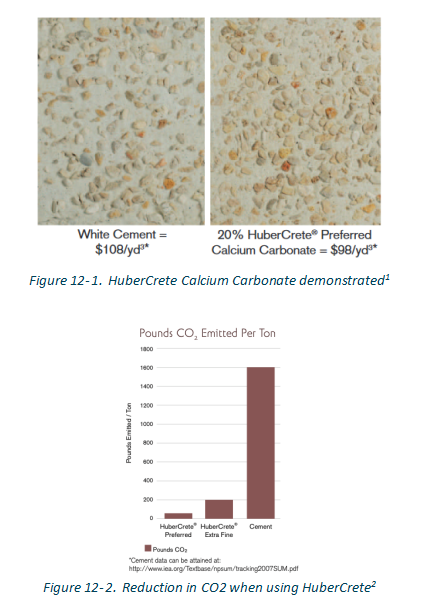
Fly ash has also been used to reduce the clinker content in cement to improve the workability of plastic concrete and the strength and durability of hardened concrete. Fly ash was traditionally collected as a waste product from coal-fired furnaces and recent reductions in coal use mean that fly ash is not a sustainable or economical product,. A new alternative for fly ash is calcium carbonate, such as HuberCrete® Calcium Carbonate, which can be used to levels of up to 20% in cement mixes (Figure 12 1). The product offers the advantages of fly ash as well as better green strength, self-compacting properties, improved pumpability and smoother surfaces, while reducing the CO2 footprint (Figure 12 2). The product can be used as a partial replacement for fly ash in concrete, and in white cement it can improve the whiteness of the finished product.
Omya, a producer of industrial minerals, mainly fillers and pigments derived from calcium carbonate and dolomite, and a worldwide distributor of specialty chemicals, also offers a range of ground calcium carbonate (GCC) products for use as mineral admixtures with low carbon footprint for concrete applications. These include flooring, technical mortars, and concrete, including 3D printing concrete applications. Omya also offers ceramic tile adhesives with up to 50% of various Omya calcium carbonate products to provide the right consistency.
Reducing process and lifecycle emissions
Approaches to reduce process emissions that have implications for limestone use are:
- Substitute standard cement with various speciality products that have lower carbon footprint
- Adapt processing methods so that they use less cement.
- Reduce the amount of cement used
(Process emissions can also be reduced through capturing and using the CO2 produced or by buying carbon offsets, but these approaches do not have a direct implication for limestone use so are not discussed further in this report.)
Speciality cement: calcium sulfoaluminate (CSA)
Calcium sulfoaluminate (CSA) is a specialty cement produced by heating limestone, bauxite, and calcium sulphate at about 1250°C and blending with clinker with 15-25% gypsum and/or anhydrite. It is used where high early strength and fast setting development are necessary, such as bridge decks, airport runways, patching roadways, DOT work, tunnelling, etc. CSA cements may also be used to manufacture shrinkage compensated or low shrinkage concretes grouts and mortars. CSA cements can reduce the carbon footprint because:
- Kiln temperatures are lower than for Portland cement (1250°C compared with 1500°C for Portland cement)so less energy is needed for production.
- CSA clinker is softer than Portland cement clinker, so less energy is used at the grinding mill and to pass the clinker through the kiln.
- The product has higher strength and durability compared with traditional concrete, so less concrete is needed for a given task, such as a structural load-bearing wall.
CSA cement could be an alternative downstream use of limestone if OPC production is reduced due to concerns about carbon footprint.
Geopolymer cement
Geopolymer cement is potentially a zero carbon product, developed as a cement alternative with reduced carbon dioxide emissions and used as an alternative to, or extender in, ordinary Portland cement. It is made from kaolinite, dehydroxylated to create a cementitious material, and includes no limestone. No CO2 is emitted in its production and the energy required is much less than for making conventional cement, so overall CO2 emissions are reduced by 80% to 90%. These environmental benefits mean that geopolymer cement is a big growth area and geopolymer cement products are already commercialised, although availability is still limited. All the major cement players are conducting trials; for example, CEMEX (a large manufacturer of concrete), is introducing an innovative geopolymer cement solution, predicted to be the first carbon neutral concrete product to be launched in the UK.
Geopolymer blends with Portland cement are also becoming commercially available, which reduce the quantity of Portland cement in concrete and mortars. Initially, as the blends are being developed and tested, they will be used mainly in concrete products, rather than in mass structural concrete, including in transportation infrastructure. However, innovative uses of geopolymer products such as for 3D concrete printing are also emerging, with the benefits of higher stability, adjustable setting times, and environmental benefits (see Section 13.4.1),. Constraints on the development of geopolymer cements include availability of raw materials, as well as conservative attitudes in the construction industry.
The development of geopolymer cement may reduce consumption of limestone in the conventional cement industry and suggests that Oman should actively investigate other downstream opportunities for limestone. However, growth and development of geopolymer cements could lead to increased opportunities for kaolin.
Using less cement
Following demolition, concrete waste can be collected and crushed for use as aggregate or other fillers, reducing the need for new cement and other resources and so reducing emissions associated with mining and processing (as illustrated by the Jhansi example, Section 12.3.2.1). For example, up to 25% of Portland cement can be substituted by Recycled Crushed Concrete Fines (RCCF) without altering its function. Note that such an approach will reduce the overall demand for limestone in construction, adding to the imperative to find higher value applications for limestone.
Next steps
Premixes offer a range of benefits including environmental advantages and the technology appears to be developing rapidly. They are a higher added value construction material than OPC, but they may not be a strong opportunity for limestone, as some compounds, such as geopolymer cements, do not use any limestone, and other materials use a complex combination of raw materials of which limestone is only one element any limestone. A number of premix companies are established in Oman, but they did not respond to requests for interview. Premix construction material is an area to watch for innovative product development but is not an obvious means through which to expand Oman’s limestone industry.