
Background
3D concrete printing (3DCP) is an innovative manufacturing process where concrete is extruded through the nozzle of a concrete 3D printer to form layers that print the structures in 3D. This allows rapid printing of large and complex structures, including walls and frames of buildings, bridges, benches, or any outdoor/indoor decorations or sculptures.
Most concrete 3D printers are mobile and can print on the spot with crane and robotic arm. This means that the printers can be transported between construction sites, rather than moving large pre-built structures. This is more cost effective and logistically easier, with fewer project risks, more consistency in build timelines, and accurate computer modelled quantity calculations. However, an alternative is to print structural units offsite and bring them on-site for assembly.
In outline, the process to create a 3D printed concrete building is as follows:
- A blueprint of the structure is prepared using CAD software
- At the building site, after levelling the foundations, the 3D printer is mounted on rails so it can move in X, Y, and Z dimensions
- The printer uses a mix formula that closely resembles a mortar mix, formulated depending on requirements such as fluidity, bonding, water impenetrability, seismic resistance, as well as curing and strength
- The 3D printer deposits concrete layer by layer as defined by the software
- Plumbing, electrics and fittings such as doors and windows etc. need to be installed separately
Development of 3DCP formulations
Limestone is a key component of the concrete used for 3D printing. Such concrete differs from conventional concrete, as it is formulated to deliver conflicting requirements:
- High flowability for the print extruder while remaining rigid enough not to slump after extrusion, without a framework to constrain its shape
- Structurally strong quickly enough to support additional layers while remaining workable to achieve strong adhesion between each layer of concrete
The field is developing rapidly and Table 13 1, sourced from a research paper, summarises some formulations for 3DCP mixes used in research studies. The data show that cement (containing limestone) is a significant component of mixes used for 3DCP, comprising between 20% and 50% of the material, and in one case, further limestone is added as a filler.
Table 13 1. Compositions of 3D printable concrete
| Material compositions (kg/m3) | |||||||
| Study | Cement | Fly-ash | Silica fume | Sand | Water | Superplasticizer | Fibre |
| Nerrela et al. | 430 | 170 | 180 | 1240 | 180 | 10 | – |
| Le et al. | 579 | 165 | 83 | 1241 | 232 | 16.5 | 1.2 |
| Anell | 659 | 87 | 83 | 1140 | 228 | 11.6 | 1.2 |
| Perrot et al. |
Binder content expressed as a weight: Cement 50%, limestone filler 25%, kaolin 25%, water/cement = 0.41, superplasticizer/cement = 0.3% |
||||||
| Malaeb et al. | Cement 125 g, sand 80 g, filler 160 g, water/cement – 0.39, superplasticizer = 0.5 – 1 ml | ||||||
Another study reported that printing mixes with up to 50% limestone powder by weight had better rheological properties. Limestone powder replaced some of the cement content, providing environmental benefits (because of the high carbon footprint of cement production). In addition, for cement mixes with lower percentages of additives (fly-ash, silica fume, etc.), a high percentage of limestone powder improved the compressive strength of the concrete, with concomitant cost benefits. These research studies show that limestone is a key constituent of 3DCP substrates.
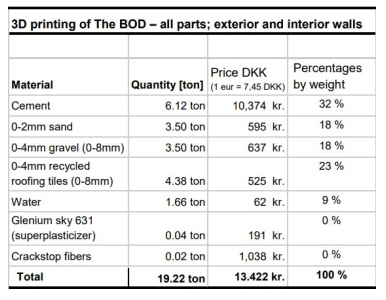
Commercial formulations for 3DCP mixes are often proprietary, but one example was supplied by the company COBOD (Table 13 2). COBOD printed “The BOD” (short for “Building on Demand”), a small 3D printed office hotel in Copenhagen, measuring less than 50 square meters, which was Europe’s first 3D printed building. The material for the BOD utilised local supplies including recycling existing roofing tiles and locally sourced sand and cement. COBOD offers a formulation service to achieve best results from their printers.
Table 13 2. A commercial building recipe used for 3DCP of the BOD building
Practical requirements for 3DCP
3DCP printers
3DCP requires purchase or hire of a 3D concrete printer. The smallest printer models cost approximately $35,000, but printers capable of printing a building are often more expensive. COBOD, the market leader in concrete building printers, can provide printers capable of printing a two-storey building for a cost of $500,000 – $550,000. COBOD printers are modular, so additional sections can be bought to upgrade the printer so that it can print larger structures. The maximum dimensions that a COBOD printer can achieve are 15m x 10m x 50m, or 12000 square meters over three storeys.
Printers must be transported and assembled on site (using a crane) or house parts can be printed offsite (for example, Witteveen+Bos has a print workshop in Dubai). Costs for each option depend on site accessibility, transport logistics, etc.
3DCP substrates
Concrete can be supplied as a pre-mix that requires only addition of water, or a local mini batch plant can be established. Pre-mixes are easy to obtain and use: for example, Heidelberg Cement supplies pre-mixes for 3D concrete printing. Set-up cost using pre-mixes is estimated at around €70,000 and pre-mix costs on average €555 per ton). Local mini batch plants require a higher initial investment (estimated at approximately €170,000) but lower cement costs, estimated at €120 per ton, and transport costs are minimised. Such plants are also an obvious route for using locally sourced limestone or other ingredients.
Economic comparison with conventional construction approaches
One report estimates that 3DCP saves 30% to 55% of the costs of conventional housebuilding because of reduced manual labour, waste reduction, and time savings. For example, a small house built by the construction company Apis Cor cost less than $10,000 to produce, and ICON, a manufacture of 3D printers, printed a compact home for less than $4,000. Although these examples demonstrate the potential for 3DCP to provide cost savings, these are very basic buildings that are unlikely to offer most of the comforts that people seek in a home.
Engineering firm Witteveen+Bos, which designs houses for 3DCP, commented as follows on possible costs for designing and printing:
- Printing a single house (pilot study) – approximately double the cost of a conventionally built house
- Printing between four and ten buildings – approximately 50% higher cost than conventional building
- Printing 100 or more buildings – significant cost savings achieved; interviewee could not provide an estimate, stating that a market study for Oman is required; savings depend heavily on sources of materials, with greatest savings if materials are sourced locally (specialised pre-mixes are extremely expensive because suppliers aim to recoup the R&D costs required for developing the material)
Economic benefits also depend on local economic conditions. For example, in countries where unemployment rates are high, the local workforce may consider 3DCP (which reduces the need for manual labour) as a threat. Equally, the economic benefit of 3DCP over conventional building is lower in countries where manual labour is inexpensive. In general, as the printing process becomes more widespread and resources are more readily available, the costs will reduce and less scale will be required for large savings.
Technological development of 3DCP
3DCP offers huge potential although technical challenges currently limit its application.
Technological benefits
3DCP offers manufacturing flexibility, with potential to create complex and non-standard structures that would otherwise be difficult and time consuming to build, including non-linear and highly curved buildings. These can be built to a high degree of accuracy as deposition can be precisely managed through the software-controlled concrete depositing nozzle and geometric subunits such as square bricks are not needed.
3DCP also offers time savings, as depositing material is faster than conventional manual building techniques. For example, in 2020, GE used a COBOD 3D printer to create a 3DCP windmill in 72 hours. In China, the architectural firm Winsun constructed ten 3D printed houses in one day, at an economic scale (nearly $5,000 for one house).
Technological challenges
Size is a limiting factor, with only small buildings currently feasible: for example, the largest MudBots 3D concrete printer build volume is 100’ x 100’ x 10’. Machines need to be scaled up to enable building of larger structures. Formulations to meet the needs of 3DCP are still under development including by companies and institutions such as RMIT University and Sika Group, the resulting formulations (such as Sika ViscoCrete) remain significantly higher than standard concrete. Structural and architectural designs must also allow for differences in material used for 3DCP.
The 3D concrete printing market
The global market
The global 3D concrete printing market was valued at $310.9 million in 2019 and is expected to reach $40,652.4 million by 2027. Estimates of growth vary significantly in different sources, with one estimating a CAGR of 17% in the 3D concrete printing market to 2026, and another estimating a CAGR of 106.5% to 2027. Although these figures vary widely, rapid growth seems likely, due largely to growth in residential property caused by rapid urbanisation, especially in developing countries. Possible constraints to growth include the need for skilled labour and capital investment, and infrastructure planning will be needed to overcome these.
MENA
Countries in the MENA/GCC region have a strong interest in 3DCP to meet demands created by rapid urbanization. For example, during the fifth International Conference for Sustainable Construction Materials in Dubai, the local government laid out a plan to have 25% of its buildings 3D-printed by 2030 to help to meet rising demand created by rapid urbanization. An example has been built in UAE by DuBox, modular design and off-site construction company, which partnered with the University of Eindhoven, in the Netherlands, and the engineering consultancy firm, Witteveen+Bos, to use 3DCP to build a concrete building locally.
Oman
Omani data indicate that the Omani construction industry declined from 2016 to 2019. However, a market study predicts overall growth with a CAGR of more than 5% from 2017 to 2026 as a result of economic diversification plans as articulated in the Oman 2040 vision, which include an aim to support tourism. For example, the Omani ministry aims to provide 80,000 rooms for accommodation, including 33,373 hotel rooms, 29,287 vacation homerooms, and 17,262 integrated tourism complex (ITC) rooms. 3DCP approaches could help to attract investment in the Omani construction industry and could potentially support the rapid construction needed to realise these ambitions.
PESTEL analysis of considerations for introducing 3DCP in Oman
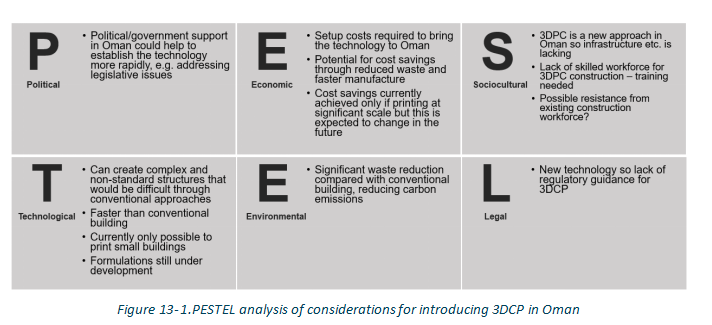
Figure 13 1 summarises issues regarding introduction of 3DCP into Oman and the following commentary discusses some of these in more detail.
Political: As a new technology, a regulatory framework for the application of 3DCP in Oman is lacking, which is important for ensuring safety (see comments under ‘Legal’).
Economic: The economic issues raised in Section 13.3.3 need to be considered for Oman. Set-up costs will be required to introduce 3DCP into Oman. An appropriate printer is needed (costing between $35,000 and $1 million to purchase). Transporting equipment from COBOD based in Europe to Oman is estimated to cost at least $5000 -$7000 by boat, as well as additional fees for land transportation on arrival. Alternatively, remote printing services and hired printers could reduce the investment needed for a pilot study, but estimated cost for such an approach will depend on details of the pilot. Note that many printing services operate from Dubai so transport from here will likely be needed. Other costs include purchasing land, printing material (concrete), and training costs.
Sociocultural: Although 3DCP is an emerging technology, success has been demonstrated in several countries: for example, printed houses are available for purchase in the USA, Germany, and Dubai, among other countries. However, as an entirely new technology in Oman, a practical infrastructure for enabling the technology will need to be established, as well as training of the construction industry workforce. There is also a risk of the existing Omani construction workforce viewing the introduction of 3DCP as a negative because of reduced labour needs, and appropriate support or retraining programs may help to prevent or manage such reactions.
Technological: The issues discussed in Section 13.4 provide both advantages and challenges in Oman, and the technological feasibility of any Omani project should be assessed at the outset.
Environmental: The construction industry produces a significant amount of waste: for example in the UK, the industry produces 53.5 million tons of waste annually, of which over half goes to landfill. In 3DCP, controlled placing of concrete greatly reduces waste. Given the huge carbon emissions associated with cement production, this could lead to significant environmental benefits.
Legal: Construction sites are regulated to meet safety standards and there are calls in many countries to develop legislation specifically to address 3DCP manufacturing. For example, regulation could address issues such as repeatability and dimensional stability, to ensure that safety standards are met regardless of the printer and the concrete used.
Business canvas
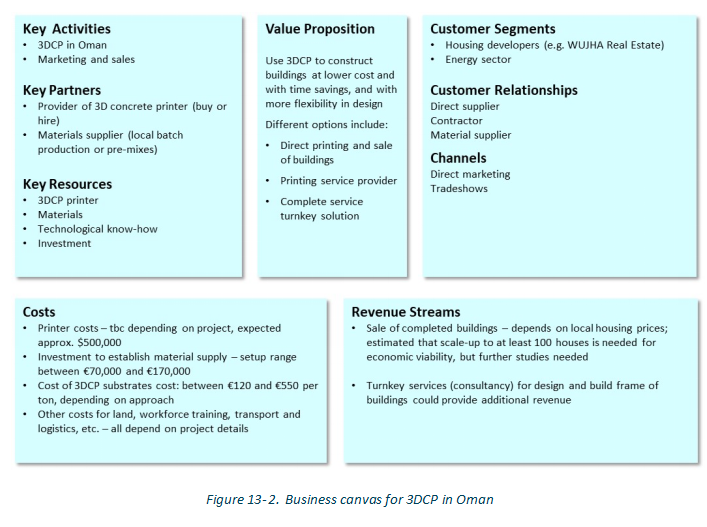
Next steps
Making progress in this area requires a market feasibility study and decisions on how to source a 3D printer and sources of material. Partnerships will be needed and the organisations identified in Table Error! No text of specified style in document. 1 are recommended as starting points.
Table Error! No text of specified style in document. 1. Potential partners to develop 3D concrete printing.
| Organisation | Description |
| German University of Technology in Oman (GUtech) |
GUtech recently purchased a large concrete printer from COBOD International, with delivery expected in August 2021. The University plans to use the printer to teach manufacturing and GUtech’s printer could provide access to expensive equipment. Overall, broader mutual benefit for the IIA and GUtech could emerge, with students gaining industry experience and the IIA benefitting from local graduates with skills in 3DCP. GUtech would be keen to hear from the IIA directly. Contact: Dr. Hussain Al Salmi (Hussain.alsalmi@gutech.edu.om) |
| COBOD International A/S |
COBOD is the current leader in 3DCP printers. The company is part owned (20%) by the construction company Peri, which has allowed the manufacturing technique and printers to be used in many projects. COBOD printers offer the largest print volume and the modular design means they can fit different project dimensions. The company can support with development of a cement formulation for the printer as well as with setup of a local batch plant. COBOD also offers training services, either hosted at the COBOD headquarters in Copenhagen for free, or supplying a trainer to travel to Oman to deliver training on-site for a cost of $7,000. Contact: Leith Sharar (ls@cobod.com) |
| Witteveen+Bos |
Witteveen+Bos is an engineering consultancy that has developed several 3DCP buildings including 3D printed houses with load-bearing walls and the first 3D printed bridge. The company has a proven track record in design for 3DCP and works alongside the University of Andover and University of Ghent to be involved with industry research, including optimising the concrete formulation. Witteveen+Bos is currently engaged in redevelopment of the port of Sohar and conducting a feasibility study on Omani strategic pipeline projects, but is not yet using 3DCP in Oman. Witteveen+Bos also conducts market research and could also help with the market research needed to establish the feasibility of 3DCP in Oman, including assessment of labour costs, technology availability, and material costs. Contact: Daniël Dusseljee (daniel.dusseljee@witteveenbos.com) |
| Heidelberg Cement |
Heidelberg Cement is one of the world’s largest manufacturers of building materials with a history extending over 150 years. Their products are used in the construction of houses, traffic routes, commercial and industrial facilities. In 2021 the company won the German Innovation Award for the first 3D printed house in Germany, Beckum, using a large 3D concrete printer made by COBOD (with Peri). Heidelberg Cement prioritizes sustainability, using alternative raw materials from waste streams, building energy efficient buildings and investing in 3D printed buildings. Heidelberg Cement, COBOD and Witteveen+Bos previously worked in a consortium to build the first 3D printed house in Europe. The company could supply pre-mixes for a 3DCP pilot study in Oman. Contact: Wolfgang Dienemann (Wolfgang.Dienemann@heidelbergcement.com) |