
Sarooj for heritage applications
Background
Sarooj is a type of artificial pozzolan that has been widely used in Oman and surrounding region for thousands of years. Sarooj has been used as a hydraulic binder in various applications including mortar, render and the construction of the Aflaj system in Oman. The recipe for Sarooj consists of clay, lime, sand and water. These materials are mixed and calcined at high temperatures to increase the reactivity of the final binder.
Typical facilities for production of Sarooj
The traditional method of sarooj production, known as Almahabbah, involves the use of clay-based soils. The soil is sieved to remove stones and is then mixed with water and formed into discs. Once dried, the discs are placed amongst layers of date palm trunks along with chunks of limestone to form the Mahabba. The Mahabba is set ablaze and left to burn for several days. After 1-2 months the soil disks are recovered from the Mahabba and are ground up to a fine powder – which is the final sarooj.
About the market for Sarooj
Sarooj is a very small niche of the plaster, mortar and render market as its primary application is in the restoration of heritage buildings such as forts and castles. There are over 500 forts, castles and lookout towers in Oman[51] and many more in the surrounding region including 70 in the Emirate of Abu Dhabi[52] for example. The preservation and restoration of this rich cultural history is seen as a high priority for the government of Oman, both to ensure the connection of current citizens with the history of the Sultanate and also as attractions for tourists.
There is therefore interest in restoring and preserving historical forts and castles, with a particular emphasis on using authentic materials that are closely matched to the materials originally used in their construction. In recent years, the Ministry of Heritage and Culture in Oman has struggled to source sarooj for heritage restoration projects due to limited supply and the variable quality of sarooj produced using traditional methods. This problem was recognised over 20 years ago and a team from Sultan Qaboos University received funding to perform research into the characteristics of sarooj and potential methods for efficient production of high quality sarooj. This project led to the proposal of the mobile rotary kiln mentioned in the previous section. However, this technology has not been commercially exploited and so the lack of sarooj production in Oman remains a challenge for restoration projects.
Whilst it is not been possible at this stage to establish any reliable estimate of the market demand for Sarooj products, feedback from two independent experts (see some experts) suggest that there appears to be a viable market for small scale production of Sarooj in the GCC region.
Canvas
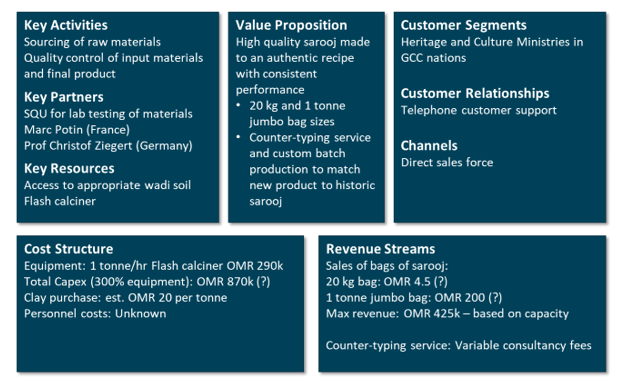
Figure 39
Further Information
This page provides an introduction and overview of the nature of the selected opportunity. For more detailed information or to get involved with this opportunity, please contact IIC: info@iic.om