
Basalt fabric production
Description of the opportunity
Basalt fabrics (Figure 35) offer a wide range of possibilities for products which take advantage of basalt physical properties such as high tensile strength, light weight and fire retardancy. The fabric’s appearance, properties and end-use depends how it is constructed. Today there are number of niche commercial applications. Most basalt manufacturers tend to have a stock range of fabrics but also continually work with end customers to explore custom requirements in order to expand the range of end applications.
In comparison with fabrics made from glass fiber, those made of basalt have better sound insulation, dielectric and mechanical properties. At the same time chemical resistance of basalt fabrics gives an opportunity to use them in corrosive medium. However, the major potential market for basalt fabrics is as a structural material in composites.
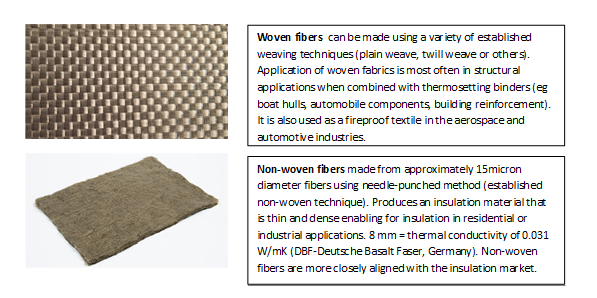
Figure 35: Examples of basalt fabrics
Applications and end markets
There are hundreds of potential applications for basalt fabrics due to their inherent versatility. By far the most significant market is to utilise fabrics as part of a composite system, which involves combining the woven fiber with resin and an appropriate molding or forming technique. This has application in automotive, aerospace, marine sector (boats and yachts as show in Figure 36) as well as applications in reinforced pipes / pressure storage tanks (which has partial overlap with pipes market).
In this respect, basalt fabrics can be regarded as an important component of the fiber composites market, where manufacturer requires the fiber to be supplied in woven form. Often fibers are supplied in as prepreg, which means the fiber has been pre-impregnated with a resin system during manufacture.
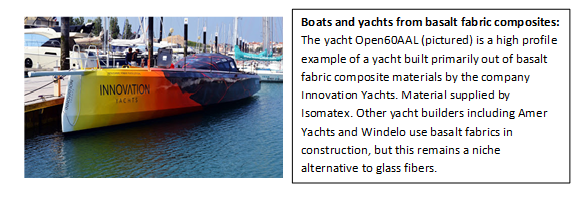
Figure 36: Examples of Boats made from basalt fabric composites
Basalt fabrics for non-composite applications:
General-purpose fabrics are useful, for example in fire feltings for suppression of fires resulting from ignition of highly flammable liquids, in particular gasoline. Basalt tapes provide fire resistant insulation for electrical cables and underground ducts. Some applications of fibers rely on their aesthetics where they have been used for applications such as automotive upholstery and unique furniture production.
Reports in Basalt Today highlights the increasing prevalence of basalt fabrics products at Techtextil and Texprocess 2019. It illustrates the number of companies adding basalt fabrics to their product line and some end applications.
Market of the opportunity
An approximate size for the current global basalt fabric market is estimated to be US$ 70m (0.5% of the combined glass and carbon fiber fabric market). Currently, it only represents a tiny portion of the global market for structural composite fabrics.
The long-term market for woven basalt fabrics will be heavily dependent upon its ability to substitute woven carbon and glass fibers in composite applications. The increasing prevalence of hybrid composites (utilising combinations of fiber types), improves the prospects for basalt fibers as it increases the number of use cases.
For comparison, the global fiberglass fabric market size was estimated at US$ 9.27 billion in 2017 (source: Grand View Research). The overall market for carbon fiber was US$ 4.7 billion in 2019. A large proportion of this is woven material and “prepreg” (Markets and Markets).
Whilst there is future potential in this market it is unlikely to be an attractive opportunity for Oman investment in the short term for the following reasons:
- Current CBF supplies have a competitive advantage in being able to produce woven basalt materials with greater customization for high value applications by amending properties at the fiber level (this is only achievable with control over the fiber manufacture process).
- Existing markets for standard woven basalt fibers not used for application in composites are niche (for example, fire retardant blankets), and there is limited scope for adding value here.
- A new company in Oman seeking to supply fabrics for composites could add value to standard fabrics by pre-impregnating them with resin for application in composites but this would require strong links to end markets such as automotive (challenging to achieve) and it would be challenging to compete in this market without vertical integration of processes.
- The Innovation centre for design and prototyping presents a lower risk avenue to exploring and testing opportunities in this market by making low volume composite products utilizing basalt fabrics.
Typical production facilities
Production of basalt fabrics requires weaving equipment. This varies in sophistication depending upon the end product and how tight the specification is. Most basalt fabrics are woven on relatively standard technology looms producing a range of stock fabrics with varied weave and fiber diameter.
The forefront of the fiber weaving industry, often applied to carbon fibers in aerospace applications, involves proprietary customized equipment which enables much tighter tolerances to meet specific performance criteria. Sigmatex is one example of a company focusing on carbon fibers.
Further Information
This page provides an introduction and overview of the nature of the selected opportunity. For more detailed information or to get involved with this opportunity, please contact Talal Al Wahaibi at the IIC: Talal.AlWahaibi@iic.om