
Background
Pottery and ceramics sector market overview
The use of clay pottery is an ancient craft used in early civilizations. Stoke on Trent (UK), otherwise known as “the potteries” was at the centre of innovation during the industrial revolution where increasing mechanization and production technology allowed ceramics in complex forms to be manufactured at low costs. We have relied heavily on expertise and case studies from Stoke on Trent, especially with regard to the lessons learned from businesses that have survived the more recent transfer of manufacturing to low-cost economies.
As slip casting allows for complexity, repeatability, and quick processing times not achievable making pieces by hand, slip casting will become an enabler for Omani potters to compete with imported products and develop new and unique designs that combine Omani Heritage with modern thinking.
Glazes are used to seal the fired surface of clay articles, and to provide decoration. Glaze technology is a field in itself, allowing a multitude of designs, patterns, textures and colours. It is essential for Omani potters to have ready access to a full range of glazes in order to experiment with different design ideas and create a strong brand.
[/expand]
Potential for growth in Oman
The breakdown of trade balance and imports for pottery and decorative ceramics is shown in Table .
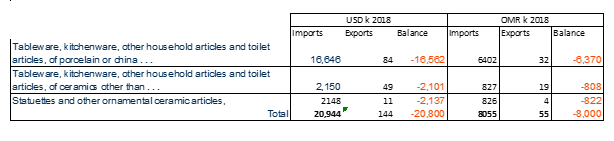
Figure 50
The opportunities
1- Pottery lab for prototyping, education, and small-scale production
- Background
Oman has a heritage in the production of fine pottery and ceramics dating back over 4000 years. This tradition continues in areas such as Bahla, which is the epicentre of pottery activity in Oman. The number of active potters in Bahla, and elsewhere in Oman, has declined over the years[65], leading to efforts to reinvigorate the pottery and ceramics industry.
A Pottery and Ceramic Training and Production Centre has been established in Bahla with support from the Public Authority for Craft Industries. The Centre trains new potters in the traditional methods and also enable small scale production. The Centre produces 200-300 pieces of pottery per day, including plates, bowls and decorative items[66].
Research from the local scouting identified that potters and artists using traditional methods struggle to produce pieces at suitable prices for the local market due to the labour intensive nature of traditional processes. It was also noted that there is a lack of new potters entering the industry, with many of the experienced potters reaching retirement age. There is therefore a need to encourage a new generation of young people in Oman to enter the pottery industry. Based on these insights about the current state of the pottery industry in Oman it is proposed to develop:
“A Pottery Lab offering prototyping and small-scale production services for artists and designers as well as training and educational courses for children, adults and aspiring artists.”
About pottery labs
Pottery labs have been established in countries around the world as a means to supporting innovation, education and small-scale production.
About the market for Pottery Lab services
There are three target markets for the Pottery Lab:
- Prototyping – Independent potters and artists interested in trying new techniques and developing their pottery skills.
- Education – Wide range of people that want to develop skills in pottery including school children, hobby potters, and artists that have not previously worked with clay/ceramics.
- Small-scale production – Established potters and artists that have been successful at selling their work but now want to start small scale mass production.
- Canvas
The Pottery Lab business model is represented in three canvases, corresponding to the prototyping, education and small-scale production aspects. It is proposed that the Pottery Lab is established in three phases.
- Phase 1: Prototyping (Figure 57)– Starting with the prototyping aspect will support local artists and encourage innovation and experimentation to build a name for the Lab and to identify potters and artists who may be interested in running classes and courses.
- Phase 2: Education (Figure 58) – Begin with simple education courses for the public to get involvement and publicity; development of advanced courses can build from these foundations.
- Phase 3: Small-scale production (Figure 59)– Small Scale Production will require more space and investment, which makes it advisable to wait for feedback/evidence of demand from potters and artists involved in the prototyping activities before launching. It is possible that this function may be delivered by the Ceramic Design Incubator, although it is likely that both will be necessary, especially if they are in significantly different locations.
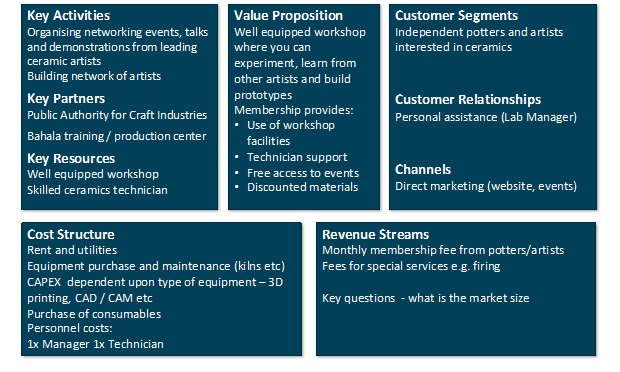
Figure 57: Business model canvas for the prototyping aspect of the Pottery Lab
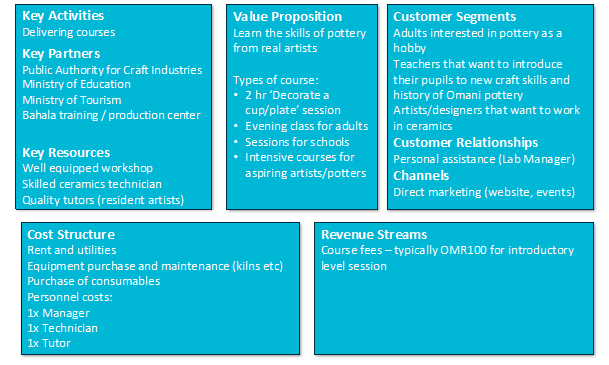
Figure 58: Business model canvas for the education aspect of the Pottery Lab.
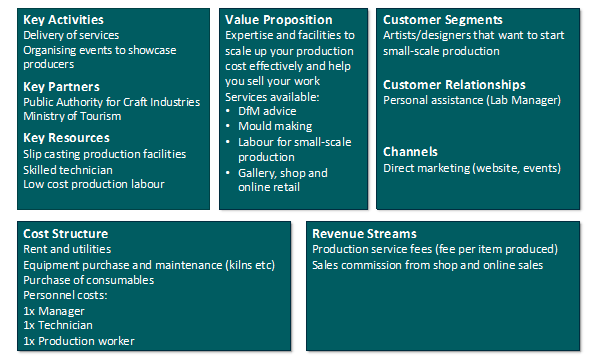
Figure 59: Business model canvas for the small-scale production aspect of the Pottery Lab.
Further Information
This page provides an introduction and overview of the nature of the selected opportunity. For more detailed information or to get involved with this opportunity, please contact IIC: info@iic.om