
Mid-range tableware
We are defining “mid-range”, as sitting between the very high volume, highly automated low-price segment typically based in-low cost economies using large factories; and the high end, high price point low volume market covered in section 3.3. Products include themed and personalized mugs, plates, teapots, plates and bowls etc. Success in this market will depend upon successfully mastering the medium volume manufacturing processes whilst simultaneously developing a brand, market reputation and loyal following. Many consumers will collect a range of products from a similar design and build this collection over several years as shown in below figure.
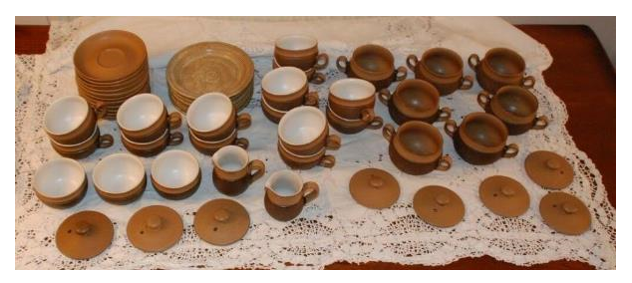
Figure 64
Internationally there are many examples of tableware brands producing products in this segment, using semi-automated processes such as slip casting, jigger-jolly and in some cases compressed powder moulding.
Omani potters primarily use traditional methods and often struggle to produce pieces at prices competitive with imports. For example, the Bahla pottery factory mainly produces hand-made, traditional ceramic products, including some tableware. These products tend to be low-fired pieces with little glaze and generally achieve a low price point due to comparatively low durability which is a key factor in pricing and customer perceived value. We intend that this opportunity will be not directly competitive with Bahla and could potentially be an opportunity that they would be interested in being associated with in some way.
We have used Emma Bridgewater (UK) – Turnover OMR 9 Million – as a guiding case study for this opportunity and inspiration for an Omani interpretation. We expect the initial scale to be 1/17 of this size as a start point.
About the market for mid-range tableware in Oman
The demand for tableware will increase in line with population growth and as young Omani’s set up home. Oman currently imports OMR 8 million of ceramic tableware, and this opportunity is targeted at substituting a proportion of these imports, and the future growth in the sector.
More research will be needed into the tastes and preferences and trends in Omani consumers, and to establish the potential for export, particularly into the GCC.
Canvas
The business model canvas presented below assumes that manufacturing will be done in-house. However, manufacturing could be outsourced initially. This would reduce the initial CAPEX requirements significantly and would help to reduce the commercial risk of subsequent investment in production facilities as the first phase (with outsourced production) could be used to prove designs, brands and market demand.
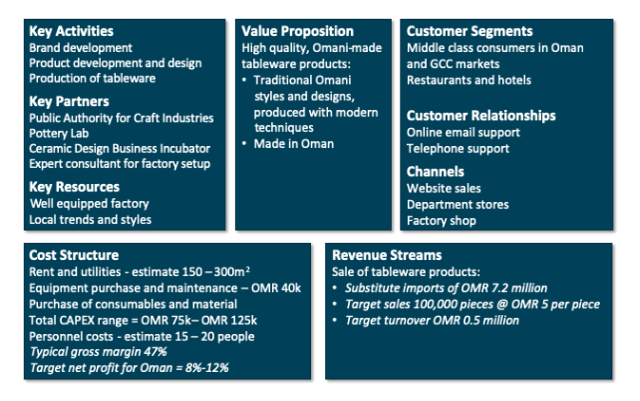
Figure 66
This opportunity can be started with a nominal investment prior to the bulk CAPEX being required. The start point is the engagement of a designer with the same passion and vision as Emma Bridgewater. Design is the most important consideration for engagement with consumers and can be developed and proven in the market at small scale through the high-end ceramic business incubator. Significant orders secured prior to the factory being ready for volume production could be subcontracted to ceramics companies – possibly in India in the first instance.
The trigger for the need for a factory depends on two things – the availability of skilled people and evidence of sales potential.
It is suggested that when a sales turnover potential of OMR 0.5 million is demonstrated with sufficient forecast confidence, this can be seen as a trigger point for the investment. Bulk sales orders will be secured through retailers, specifiers (Interior designers) and direct sales to commercial entities such as hotels. Typically, retailers would expect a 40%+ share of the retail margin and interior designers 20% depending upon their terms of engagement with clients (fixed fee vs reseller margin). These assumptions need to be checked in the Omani context during business planning.
Further Information
This page provides an introduction and overview of the nature of the selected opportunity. For more detailed information or to get involved with this opportunity, please contact IIC: info@iic.om