
Basalt Innovation Center For Design And Prototyping
Description of the opportunity
The innovation centre will enable space for investigating, testing, developing and prototyping new processes and products based on basalt materials. In addition to undertaking these practical activities, the purpose of such an innovation centre will be to:
- Serve as a focal point in Oman for industrial knowledge and expertise in basalt product innovation and associated sector applications
- Help build networks and cross sector relationships with companies who may represent future industrial customers or sponsors of innovative products based on basalt fiber
- Attract external interest and collaboration with similar facilities locally and globally (from university labs to industrial innovation centre), where interests are sufficiently aligned
- Focus on emerging technology in the field such as 3D printed composites
- Provide an environment which can seed potential for new businesses ideas which exploit niche, low volume, high value markets in basalt composites
In order to minimise investment required for such a hub the focus should be upon leveraging small scale facilities suitable enabling mock-ups and testing of different products and concepts. This includes facilities for activities like 3D printing and lay-up molding. These can be thought of as ‘high leverage, low cost’ facilities. Facilities may be added to in time based upon sector developments.
The innovation hub should also have a remit to investigate high end and cutting-edge applications of basalt which pushes boundaries or applies current knowledge into new product applications. In this respect, intellectual capital, creativity, design development of know-how will be just as important as equipment.
Strategic alignment with priority markets in Oman
It will be important to ensure the centre is aligned with long- and short-term basalt industry initiatives in Oman. This will help its activities to have synergy and offer support with those activities where it is practically possible. In this way the centre can provide some resource as an external R&D facility. In the longer term these combined activities will reduce reliance on imports of materials and know-how.
Demonstrator projects and prototypes with the potential to seed new businesses and services
Demonstrator projects are a way to show proof of principle for simple products and concepts based on the use of basalt derived products and materials. These can leverage both pioneering and traditional production processes.
Hand lay-up process: The hand lay-up processes requires minimal investment in equipment and enables the manufacture of a wide variety of simple composite structures from basalt textiles. Marine products such as surf boards, paddle boards or even boats can be made with this process, in addition to a wide variety of other structures and components from automotive parts to household furniture. Even though this is not a pioneering construction technique, the use of basalt as a composite material platform will make the end products unique.
3D printing: In addition to the use of traditional moulding techniques, there are emerging technologies which enable 3D printing of composites, including basalt composites. This technology may initially be used for prototypes and to experiment with different formulations and formats. It is also viable that it could also find very niche market applications for production of composite components and be used as a voluble resource for outsourced R&D.
Market of the opportunity
The innovation hub is intended to make contributions to a range of range of basalt fiber end markets. Whilst it is not primarily intended as a direct revenue generating organisation in the short term, there are opportunities for revenue generation.
Market for 3D printing of composites:
One market of note relates to application is 3D printing of composites. As of 2019 the 3D printing composites market accounts for less than 0.1% of the total composites part manufacturing market. By 2024 this market is predicted to reach US$ 187m (Stratview Research) and research firm IDTechEx estimates the market could be worth US$ 1.73 billion by 2030. Whilst carbon fibers are predicted to be a dominant reinforcing fiber material, there is scope for basalt fiber to demonstrate its potential and gain a foothold as one of the materials of choice in this new manufacturing technique.
Revenue generating opportunities:
As the innovation lab develop experience and know-how, there may be opportunities for revenue generating activities such as outsourced R&D, outsourced prototyping or low volume production. For example, the production of parts for sectors ranging from automotive and aerospace to marine or interior design. As the market for 3D printed composites continues to expand, the capability to print basalt or basalt carbon hybrid composites will offer a key point of differentiation.
Production using basalt composites either hand lay-up or 3D printing techniques offer potential value in terms of either physical properties, aesthetics, novelty or all three.
The market for value added products based on basalt and basalt fibers touches practically every sector and industry. Particular sectors marine, automotive, construction or architectural.
Key technical trends
One of the functions of the innovation hub will be to develop and help shape an understanding of the technical trends in the field including emerging, applications and production technologies. Some example of known trends at the forefront of basalt includes:
- The use of basalt fibers in hybrid composites (combining basalt with glass, carbon, flax or other fibers)
- The use of basalt fibers in 3D printing
- Exploration of areas where basalt can offer the best cost-performance advantages and play a greater role in different markets
- Addressing technical challenges
The lab will not be able to cover all areas, particularly where large scale industrial equipment is required. However, it should position itself to ‘high leverage, low cost’ areas.
Typical production facilities
The innovation hub will start with some core facilities and equipment including 3D printer(s) and facilities for simple hand lay-up construction:
3D Printers:
There are a number of emerging and established companies supplying 3D printers suitable for composite printing. Examples of companies pioneering 3D printing of composites includes Stratasys (US), Markforged (US), Desktop Metal (US), Arevo (US), 9T Labs (Switzerland). Just one company, Anisoprint, has demonstrated capability of printing basalt fibers. This relatively small company is based in Russia but with offices in Luxembourg. Other printer platforms have the potential to print basalt fiber composite materials but this may require some development and testing.
When 3D printing composites, fibers can be added to a matrix material as chopped fibers <1mm length, or in continuous form. Chopped fibers are mixed into traditional thermoplastics such as nylon, ABS or PLA, helping increase stiffness and strength of components. Continuous fiber composites are more challenging to print because the fibers need to be integrated into the thermoplastic continuously as the thermoplastic is being extruded. However, these continuous printed fiber composites offer superior physical properties and there is more scope to optimize a part’s strength to weight ratio and material consumption using (Design for Additive Manufacturing) DfAM techniques.
A range of continuous fiber printing platforms and approaches are emerging using slightly different approaches. Markforged calls their technology Continuous Filament Fabrication (CFF), whilst Anisoprint calls it Composite Fiber Coextrusion (CFC).
Silicon Valley based company Arevo use an entirely different proprietary platform Directed Energy Deposition technology, in which a laser is used to heat the thermoplastic feedstock and fiber reinforcement material at the same time as a roller compresses the two together. This technology was used to manufacture the world’s first 3D printed carbon fiber eBike, the Emery One (Figure 43).

Figure 43: Emery One: 3D printerd carbon fiber eletric bike
Hand Lay-up:
There is practically no equipment required for this process apart from the materials used (basalt fiber fabric, resin and roller for application). The mold is used to for the desired shape. In most cases the product is released from open molds, but the mold may become part of the final product if it is encased in the composite laminate, like (like the foam core of a surfboard).
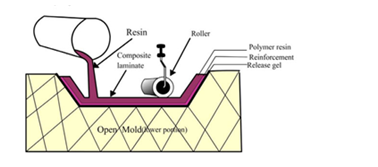
Figure 44: Handy Lay-up Process
Other facilities:
Other facilities which may be valuable (but are not essential) include mechanical tests equipment to characterise polymers and composite materials (in accordance with ASTM, EN, ISO, and other relevant international standards within composites testing). Common tests include:
- Mechanical properties (flexural, tensile, interlaminar, compressive, shear)
- Impact and compression after impact
- Fracture toughness and fatigue
- Structural tests
- Thermal analysis tests
The specific prioritization of this test equipment would require closer examination. It may be sufficient to adopt minimal mechanical tests to assess core physical properties or outsource testing if it is unlikely to be required on a regular basis.
Business Canvas
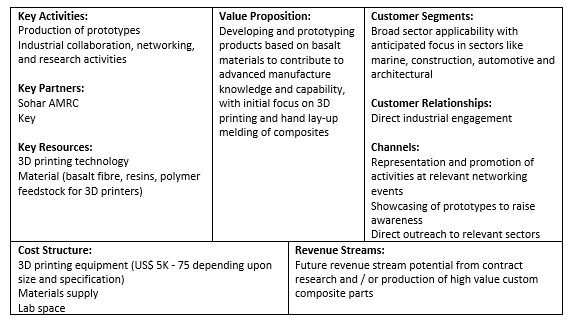
Table 15
Further Information
This page provides an introduction and overview of the nature of the selected opportunity. For more detailed information or to get involved with this opportunity, please contact Talal Al Wahaibi at the IIC: Talal.AlWahaibi@iic.om