
Disposable ceramic cups
Background
Disposable ceramic cups, as shown in the figure below, are commonly used for serving tea by street vendors throughout India. Known as ‘khullads’, ‘puruas’ or ‘bhaar’ depending on the region, the cups are designed to be cheap and quick to produce and disposed of by simply tossing them to the ground, where they break into pieces and dissolve into clay again after rain and some time.
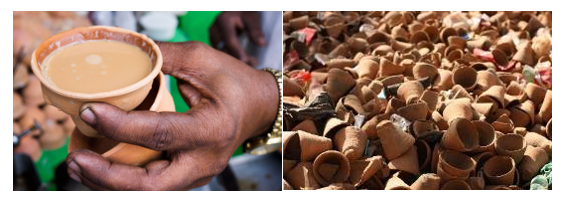
Figure 67
In Oman, coffee shops generally sell tea and coffee in disposable paper or plastic cups. Paper coffee cups are difficult to recycle due to the polymer lining they contain and there is limited recycling infrastructure in Oman for disposable cups meaning that the majority of disposable cups are either landfilled or end up as litter.
At the same time, many coffee shops in Oman are looking for ways to improve their customer experience and differentiate themselves from multinational chains that have a growing customer base in Oman, particularly amongst teenagers and young adults.
There is therefore considered to be interest in exploring the potential for low cost disposable ceramic cups manufactured on a large scale using modern production techniques.
About the market for disposable cups for hot beverages
In the UK, 2.5 billion disposable cups for hot beverages are used every year. There is no data for the number of disposable cups for hot beverages used in Oman or the wider GGC market. Therefore, an estimate has been created by analysis of hot beverage consumption in the region, with the results shown in below Table .
The first rows show the annual coffee consumption per capita in each country. This is then converted into the approximate number of cups of coffee per capita based on an estimate of 10g of coffee per cup. The next two rows show the same thing for tea, using 3g of tea per cup. This then gives the total annual cups of hot beverage per capita for each country. Based on UK data, it is estimated that around 1 in 26 hot beverages are purchased from a coffee shop and consumed from a disposable cup. In Oman, it has been observed that it is more common to purchase hot beverages in a ‘drive through’ style, remaining in your vehicle outside of the coffee shop rather than entering the premises. The frequency of disposable cup use is therefore likely to be higher than in the UK, so a ratio of 1 in 20 hot beverages using a disposable cup has been assumed. Multiplying these per capita figures by the population for each country gives the total disposable cups used per year. The total is 1.2 billion disposable cups per annum in these selected GCC markets.
For the purpose of this application, it is recommended to focus on coffee shops in the Muscat Governorate as the initial market. The population of the Muscat Governorate is around 1.4 million, which suggests that 30.8 million disposable cups are used per year in this region. A target of 15% market share would require sales of 4.6 million cups per year.
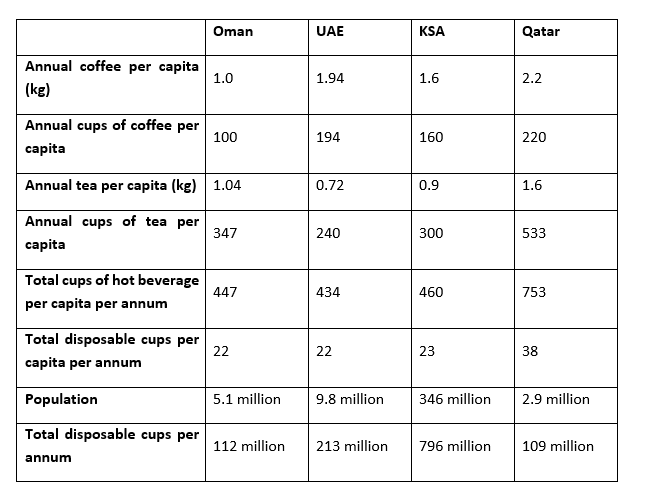
Table 1
In terms of pricing, khullad ceramic cups are available in India for between 10 and 60 Baisa per cup. For conventional paper and plastic disposable cups, there is significant variation in the price depending on the size of the cup, single vs double wall construction, inclusion of printed branding, and whether the material can be recycled/composted. Below we present some price benchmarks for a 100-200ml cups.
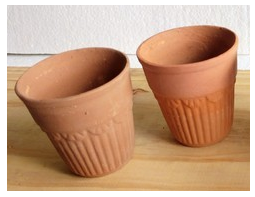
Ceramic ‘khullad’, unglazed
100 ml – 10 Baisa per cup
Source: https://www.indiamart.com/proddetail/tea-cups-kullad-20445719191.html
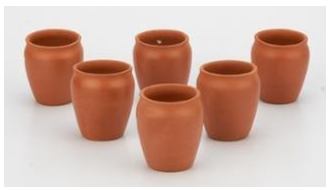
Ceramic ‘khullad’, unglazed
100 ml – 42 Baisa per cup
Source: https://www.indiamart.com/proddetail/clay-glass-set-6-piece-100ml-20380870112.html
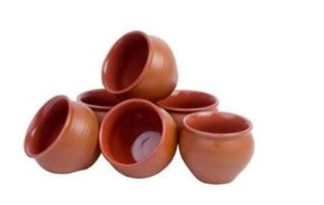
Ceramic khullad cup, glazed
100-150 ml – 62 Baisa per cup
Source: https://www.indiamart.com/proddetail/ceramic-kulhad-21118829833.html
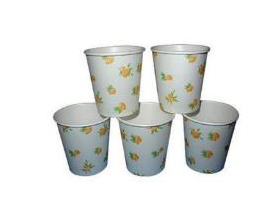
Single wall paper cup, with branding
100 ml – 2.2 Baisa per cup
200 ml – 3.6 Baisa per cup
Source: https://www.indiamart.com/proddetail/disposal-paper-cup-20887057455.html
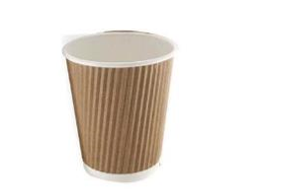
Ripple wall paper cup, no branding
150 ml – 10 Baisa per cup
Source: https://www.indiamart.com/proddetail/disposable-coffee-cup-17769363433.html
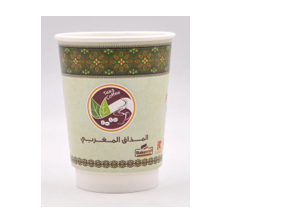
Given that the premium paper cups currently cost around 10 Baisa, it is suggested that the maximum sales price for a khullad cup in Oman would be 20 Baisa per cup.
Therefore, if the target of 15% market share in the Muscat Governorate were achieved, the sales value would be OMR 92,000 per annum.
Typical facilities for producing disposable ceramic cups
Traditionally, khullad cups have been produced by throwing on a potters wheel – as shown in Figure 39 and this video clip[79]. Once, thrown, the cups are left to dry in the sun before being fired at low temperatures in a basic kiln.
Total equipment cost – OMR 169,400
This does not include material handling equipment etc.
Assuming that the total CAPEX is 300% of the equipment cost, total CAPEX would be approximately OMR 500,000.
In terms of operating costs, the purchase of clay is likely to be one of the major costs. Assuming low quality clay can be purchased for OMR 30 per tonne, the cost per 150 g cup would be 4.5 Baisa. According to Brian Harper the cost of potter production is typically one-third materials, one-third energy and one-third labour. This would imply operating costs of approximately 13.5 Baisa per cup.
Canvas
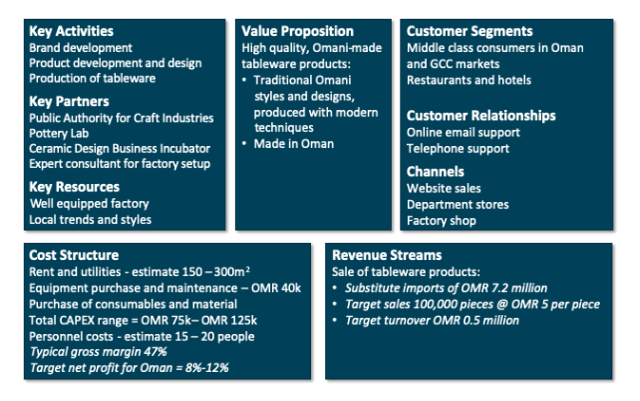
Figure 74
Further Information
This page provides an introduction and overview of the nature of the selected opportunity. For more detailed information or to get involved with this opportunity, please contact IIC: info@iic.om