
Glaze production
Background
In Stoke on Trent, at the peak of production, there were dozens of companies that manufactured glazes, in high quantities to support the even larger number of companies making ceramic pieces. Approximately 10% of the weight of a glazed ceramic article is glaze. Nowadays, companies tend to mix their own glazes, purchasing the ingredients from a network of suppliers / distributers.
Raw materials of ceramic glazes generally include: a main glass former, commonly silica, metal oxides, which act as a flux, alumina which stiffens the molten glaze and metal oxides that act as colorants and opacifiers. The traditional way to prepare glaze in Oman is by using quartz from a traditional quarry located in Muscat, mixed with clay. At high-temperature quartz starts to melt, seals the ceramic surface and gives the glossy look.
It is possible to produce base glazes, from which numerous oxides and additives can be added to create a wide range of unique glazes. Local organic materials such as palm tree ash and can be used to augment base glazes to reinforce the Omani brand, drawing on historical references to turquoise glazes. Potters will be able to tailor and experiment with the base glazes with the support of the Pottery Lab.
The justification for creating Omani glazes is though the ability to bulk buy and stock a full range of raw materials. Local production can be tailored to suit the local market trends and drive development of an Omani brand of pottery and ceramic tiles. The key challenges will be obtaining the required experience and knowledge of glaze materials and production techniques as high quality standards are essential during glaze production to ensure a product that can compete with international suppliers.
[/expand]
About the market for glazes in Oman
There are no known stockholders in Oman of glaze raw materials, which must be imported in a refined state, read for mixing. Small and medium scale potters are therefore at a disadvantage by not having easy access to reasonably priced glaze materials. This is an impediment to growth and innovation in the sector. The rationale behind this opportunity is that a market for the supply of glazes will emerge as the sector grows, and ready availability of glazes will contribute to enabling that growth in a circular relationship.
A facility in Oman that takes in less refined, and therefore cheaper raw materials will create added value and represents a business opportunity.
There are three large ceramic tile and porcelain companies in Oman that import OMR 5-6 million of glaze per annum. The Public Authority for Craft Industries currently imports small amounts for potters to use, plus there are also traditional methods for producing pottery glazes in country, but this is not done on a large scale.
“Other” materials of interest, some of which may occur in commercially suitable deposits in Oman include: potash feldspar, soda feldspar, Petalite, lithium carbonate, borax, titanium dioxide, rutile, calcium carbonate, dolomite, zinc oxide, zircon, alumina, colors.
Typical Facilities and CAPEX for Producing Glazes
Figure below shows the typical process flow, energy requirement and emissions involved in glaze production.
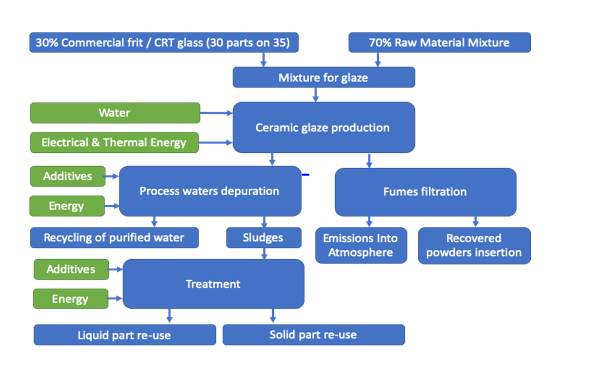
Figure 78
Canvas
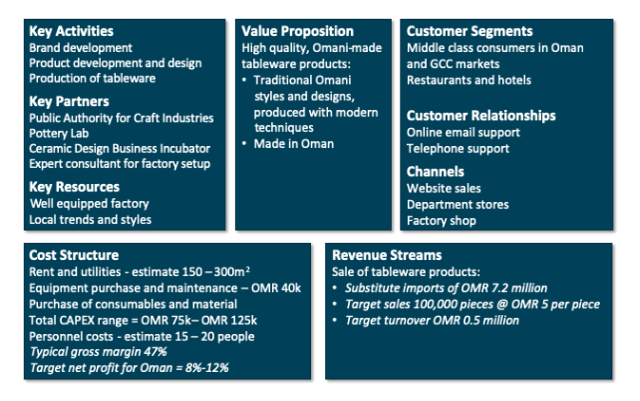
Figure 82
Import price for glazes is around OMR 300 per tonne, glaze required for tile production is 22,000 tonnes per year and glaze for required for pottery is 30 tonnes per year, which equates to a market of OMR 6.6 million per year, which is almost exclusively currently served by imports.
In common with most of the ceramics/pottery sector, Net Profit levels are expected to be in the region of 8-12%.
A key focus of research in the further development of this opportunity is around the demand from the existing tile manufacturers. It is possible that the factory could be initially based around supply to the tiles sector, providing a critical mass on which to build a business that will then grow in line with the expansion of the tableware sector.
Further Information
This page provides an introduction and overview of the nature of the selected opportunity. For more detailed information or to get involved with this opportunity, please contact IIC: info@iic.om