
Basalt Rebar And Profiles Production
Description of the opportunity
Rebar (short for reinforcing bar) is used within concrete to provide structural reinforcements to concrete buildings and structures (Figure 37). Most rebar is made from carbon steel which is susceptible to corrosion and can lead to the need for extremely expensive maintenance of structures. This problem is particularly acute in higher corrosive environments such as infrastructure near coastlines and bridges.
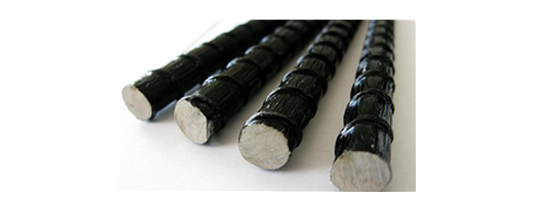
Figure 37: Basalt Rebar: Beyond Materials (Australian)
Stainless steel rebar is the current option to avoid corrosion, but it is much more expensive than standard steel making basalt rebar an attractive alternative. Basalt rebar also offers superior strength to weight ratio compared to steel.
This unmet need presents a significant opportunity for basalt rebar. Basalt rebar utilises a combination of continuous basalt fibers (~75%) bound together in a polymer matrix (~25%). It’s physical properties make it an excellent alternative to steel rebar in many applications. The proposed opportunity is for Oman to import the continuous basalt fiber and convert this into basalt rebar.
Advantages of basalt rebar
- Lighter than steel
- No corrosion or maintenance
- Higher strength
Challenges
- ~25% – 40% more expensive than traditional steel rebar
- Lower stiffness and ductility mean it may not be suitable for some scenarios
Aside from standard rebar, alternative rebar formats are used for many other construction reinforcement applications. One high volume application is basalt rebar mesh and geogrid used in road construction
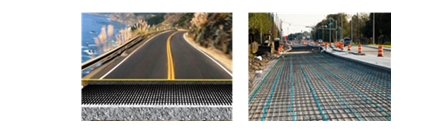
Figure 38: Basalt mesh and geogrid for road reinforcement: Basalt Projects Group
Market of the opportunity
The global steel rebar market size was USD 214.9 billion in 2018 according to Grand View Research estimates. Shifting preference towards fiber reinforced polymer (FRP) rebars as a substitute for steel in some applications within the construction sector provides opportunities for basalt rebar to take a slice of this huge market.
Data from Global Market Insights indicates the global market for FRP rebar (which includes glass, aramid and basalt fiber) is predicted to reach US$ 1.25 Bn by 2024. One estimate suggested basalt rebar may currently account for up to 10% of this (US$ 125m), although this figure has not been verified. Regardless, the market share is expected to increase as regulations are updated (in US and Europe) and large basalt fiber manufactures come online in the US, Russia and other parts of the world. The main application is in buildings, bridges, highways, and marine areas such as waterfronts where corrosion may be an issue.
Separate data for continuous basalt fiber (the precursor material to rebar) suggests it constitutes 3.39% of the US$ 2.2bn global concrete fiber market. This equates to US$ 74million. However, this figure should be taken as indicative as it only represents fiber sales, (the precursor material to rebar which is sold at lower cost per ton). This figure also includes chopped fibers sold for other forms of concrete reinforcement (beyond rebar).
Data was not readily available for the current market for stainless steel rebar. Understanding this market would provide very useful additional insight into the potential long-term market size for alternative corrosive resistant materials like basalt rebar.
Market for basalt rebar concentrated in specific regions
Whilst global figures provide some context, the actual market for basalt rebar is thought to be concentrated in some regions where early adoption has been high. For example, in Russia basalt rebar is believed to be a much more prevalent material due to state support of the basalt fiber industry, mandating its use in some circumstances.
Basalt rebar has barely begun to take hold in the US and European markets due to current lack of established standards, but this regulatory situation is changing rapidly. For example, there are currently some usage restrictions in the US, but the Department for Specification and Standards are in the process of updating standards which are anticipated to expand usage further.
This means that the potential to substitute steel in some regions will be faster depending upon local regulatory frameworks in addition to the need for concrete reinforcement which is not prone to corrosion, such as in coastal regions.
Opportunities in regional GCC markets:
According to data provided by Basalt Projects Group, rebar consumption in Saudi Arabia is estimated 4 MT and in the UAE it is estimated 3.5 MT. Around 64% of rebar consumed in the Gulf region is imported and the volume of these imports stands at around 5.8 MT per year.
Within Oman itself, imports of steel rebar have historically reached highs of US$ 300 million annually (although imports have reduced in recent years suggesting increases in domestic rebar production).
Importance of regulations
The use of basalt rebar is limited in many countries because it is not established in national construction codes. It is more widely used in the construction in Russia, Ukraine and China where there are less regulatory barriers. In the countries like the US, Canada, the United Kingdom, Italy and Poland, basalt rebar is currently only used in applications where certification is not required, such as swimming pools and garden paths.
Key technical trends
The most important trends relate to technical evaluations underway relating to the assessment of BFRP, and the regulatory landscape and associated testing by various agencies. Florida Department of Transportation appears to be one of the pioneers of this in the US. Part of this is due to the huge amount of infrastructure impacted by corrosion due to the use of steel rebar.
There are multiple working groups undertaking assessments in the path towards developing ASTM standards. Much of this information is public domain, including timelines which suggest regulatory updates may be achieved by 2021.
Typical production facilities
The primary requirement to produce basalt rebar is pultrusion equipment and pulling raw composites through a heated die creating a continuous composite profile (Figure 39). The term pultrusion combines the words, pull and extrusion. This technology is very widespread due to its use on a range of well-established materials. The process enables continuous production of composite profiles with constant cross sections and material properties.
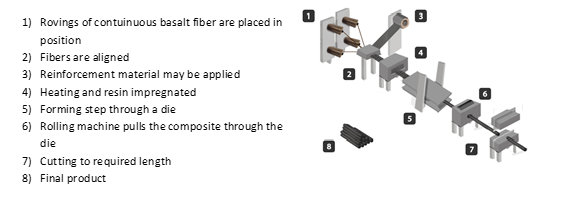
Figure 39: Facility required to produce basalt rebar
The pultrusion process can also be used to manufacture profiles made from basalt fiber used in a range of other construction applications. This includes tubes to window frames. There are a very small number of companies supplying basalt profiles, but they are understood to be very niche at this time and subordinate to the growth in basalt rebar. Further investigation would be required to better understand the long-term potential of basalt composite profiles.
Business Canvas
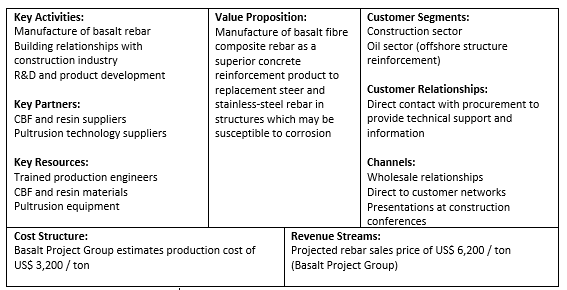
Table 13
Further Information
This page provides an introduction and overview of the nature of the selected opportunity. For more detailed information or to get involved with this opportunity, please contact Talal Al Wahaibi at the IIC: Talal.AlWahaibi@iic.om