CARBON SEQUESTRATION
BACKGROUND
Chromite ore in Oman is found within peridotite ultramafic rocks, which consists of dunite, harzburgite and wehrlite.1 Peridotite is normally found miles below sea level, but in the Semail Ophiolite sequence of Northern Oman, tectonic action has raised hundreds of square miles of it towards the surface – providing great opportunities for Oman (Figure 27‑1).2
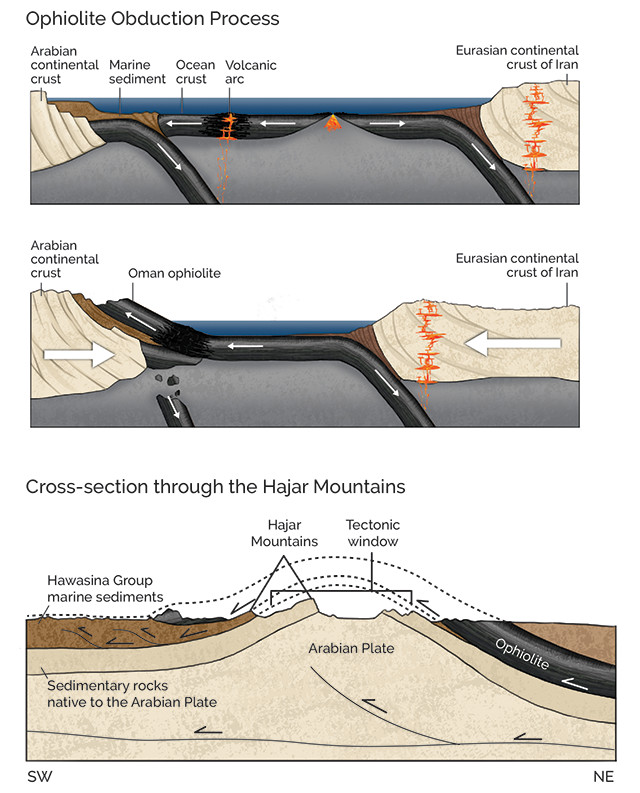
Figure 27‑1: Ophiolite obduction process.
Types of peridotite ultramafic rocks in Oman include:
Dunite: Also known as olivinite, is a dark, dense, greenish – coloured igneous, plutonic rock. It is composed mainly of olivine and may contain significant amounts of chromite, pyroxene and spinel.
Harzburgite: A peridotite composed primarily of olivine and orthopyroxene with small amounts of spinel and garnet.
Wehrlite: a peridotite that is composed mainly of orthopyroxene and clinopyroxene, with olivine and hornblende.1
Chromium mining in Oman generates considerable amounts of waste streams that are currently under-utilised. Waste streams generated after mining chromite consist of the above categories of materials. Some applications of these are listed below:
-
Carbon sequestration
-
Magnesium metal extraction
-
Building materials and paving stones
-
Decorative aggregates
Amongst these, carbon sequestration and magnesium metal extraction (discussed in section 28) potentially have more value and future potential in the global market.
Building materials, paving stones and aggregates can be sold in the Omani market, however exporting these would require transporting large quantities of a low value product outside the country potentially making it financially unviable. Also, the use of the materials for construction purposes must ensure the absence of Cr(VI), which has health and environmental toxicity issues.
Peridotite ultramafic rocks can sequester gaseous carbon dioxide into a geologically stable solid. This occurs when carbon dioxide combines with magnesium-rich rock to form magnesite2. Examples of the chemical reactions are shown below3:
The rate of natural carbon mineralization in the Samail ophiolite is on the order of 1,000 tCO2/km3/yr, demonstrating the effectiveness and suitability of these rock formations for carbon sequestration. Peridotite reservoirs have the potential to mineralize and sequester 105-108 GtCO2 and are potentially the least expensive route for combined CO2 capture from air and storage.4 This makes a strong case for Oman to enter and potentially become a major player within this market. In Oman, CO2 can be sequestered both by using mining waste or directly by direct capture into the rocks of the ophiolite sequence.
Why is carbon capture important?
CO2 emissions have been continuously rising leading to global warming. For instance, in 2000, CO2 emissions from fossil fuel, industry and changes in land use was approximately 30 billion metric tons. This number increased by over a third to 41 billion tons by 2019 (Figure 14‑21); although there was a slight drop in 2020, which is due to a global slowdown because of COVID-19.
Various governments as well as companies are investing in carbon capture and sequestration projects. For instance, in July 2020 the U.S. Department of Energy launched a multi-million-dollar funding program called FLExible Carbon Capture and Storage to develop carbon capture and storage processes.2
From an Omani perspective, peridotite is an ideal candidate for carbon capture and sequestration using a process called carbon mineralisation.3 The country is well placed to enter this sector given its access to large quantities of these ultramafic rocks and waste streams from mining.
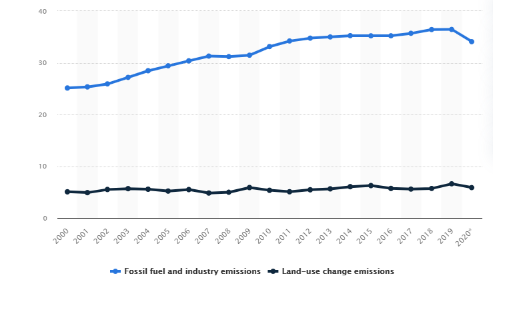
Figure‑8: Annual global CO2 emissions from 2000 to 2019
Market size for carbon sequestration
The global carbon capture and sequestration market size was valued at $1.75 Bn in 2019 and is projected to reach $6.13 Bn by 2027, at a CAGR of 19.2%.1
Based on capture source, natural gas processing had the largest market share of almost 50%. Growth in oil and gas production as well as increasing power generation will aid growth in this sector.
Oman’s oil and gas, and power generation industries can potentially benefit from/feed into a carbon sequestration company based in Oman.
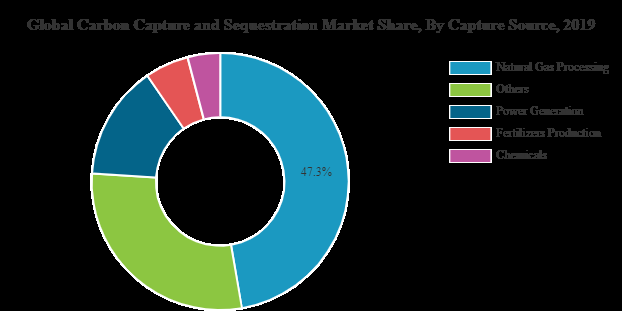
Figure 27‑3: Global carbon capture and sequestration market share by capture source (2019).
Methods of carbon mineralisation
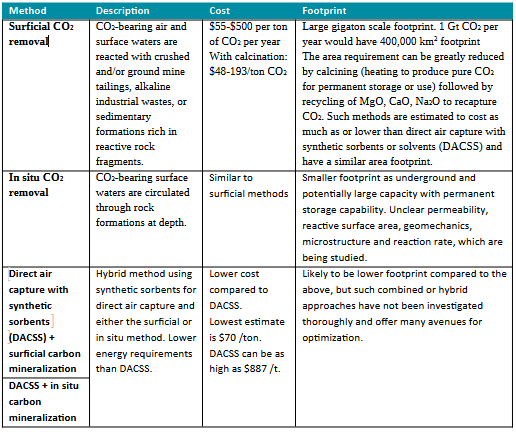
At least four different methods have been suggested to achieve carbon mineralisation in ultramafic rocks1, which are shown in Table 27‑1. The most suitable method to utilise Oman’s mining waste streams will need to be investigated by experts and some experts identified are discussed in the next section.
Table 27‑1: Methods to achieve carbon mineralisation in ultramafic rocks