
Introduction
Copper recycling is a major contributor to worldwide copper demand. It is estimated that since 1900 two-thirds of the 550 million tonnes of copper produced are still in productive use. Between 2006-2015, around 35% of copper used globally was sourced through recycling. Copper is 100% recyclable and can be perpetually recycled without loss of performance or quality. Although some applications result in unrecoverable loss of copper, such as dissipative losses due to abrasion (e.g., automotive brake pads) and copper chemicals used as animal food supplements and fungicides, in the majority of cases copper is recovered and recycled. Figure 23‑1 shows the volume of copper from mining and recycling between 2006-2015. 1
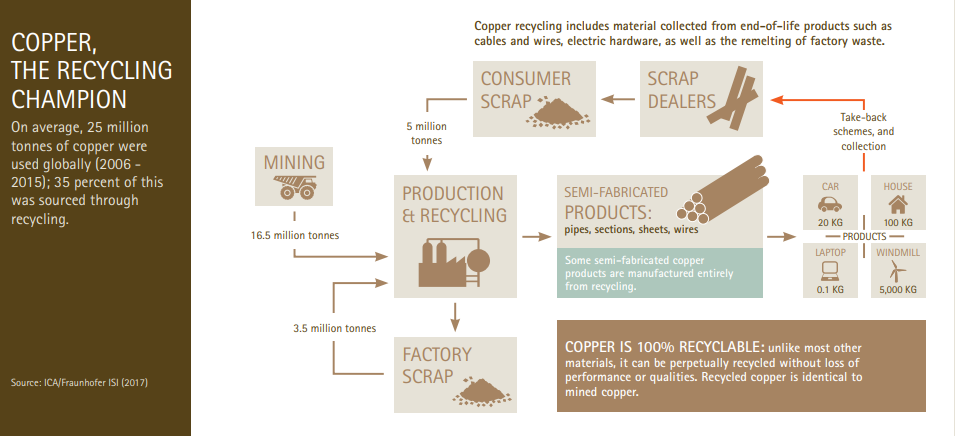
Figure 23‑1: Volumes of copper from different sources in its value-chain
Types of copper scrap include1:
New Scrap or Production Scrap: This scrap is produced as a result of production processes e.g., wire and cable manufacturing. New scrap is often directly melted and not processed via the refining and cathode production route.
Old Scrap: This scrap has over 90% copper. Old scrap is often refined in secondary smelters to produce cathode.
Complex Scrap: This scrap is from residues and electronic scrap, which is mixed with other materials
Depending on the purity of copper within the scrap i.e., whether the copper is in pure form, mixed with other materials or as an alloy, scrap is categorised based on standards specified by the Institute of Scrap Recycling Industries. Some of the categories include the following based on the main types traded in Oman2:
Mill Berry: Consists of clean, untinned, uncoated, unalloyed copper wire and cable, not smaller than No.16 B & S wire gauge, free of burnt wire which is brittle. Hydraulically briquetted copper subject to agreement.
Birch Cliff: Consists of miscellaneous, unalloyed copper scrap having a nominal 96% copper content (minimum 94%) as determined by electrolytic assay.
Copper scrap recycling in Oman
In Oman, the majority of copper that is recycled comes from the cable and wire industries as new or production scrap. There are 3-4 companies in Oman that are involved with copper recycling. Most recycled copper in Oman comes from the wire and cable industry as new scrap or production scrap. Oman’s largest copper recycling company, Al Sifa Trading processes the scrap they receive into Mill berry, Black Berry and Birch/Cliff briquettes, which are then sold to companies in Dubai for further processing. This business model of collecting scrap in Oman and exporting abroad is also followed by other scrap recycling companies in the country.
Al Sifa is now planning to invest in a copper smelter to further process their copper scrap within the country rather than export.
Apart from copper, companies also recycle the polypropylene, PVC or PE insulation materials that are part of wires and cables. These are also currently exported from Oman for further processing. This report does not cover these materials.
Pricing of scrap copper
Scrap copper price is based on prices in the London Metal Exchange and purity. Mill berry copper generally fetches 98% of the LME price, black berry 95%, while birch cliff fetches 86-87% of LME price. Scrap dealers usually hedge their stock with end-users for future sales of their scrap.1
Once new or production scrap copper is melted, as is being planned by Al Sifa Trading, sellers can command 100% of the LME price. Scrap that has copper concentrations of less than 99% can either be refined to produce higher quality copper or converted to products that do not require high purity copper such as alloys.
Possible end products from Oman’s copper scrap
Products that Oman’s scrap can potentially be used for include the manufacture of semis such as copper rods for the wire and cable industry, copper tubes for HVAC industry and alloys. The use of scrap for these applications will depend on the level of processing and refining that can be undertaken within the country.
Should existing copper scrap companies in Oman decide to process scrap within the country, they can potentially integrate any of the above end products into their process, which will add value. The rationale for these is given below:
Integrating semi manufacturing
The margins for semi manufacturing are very small – approximately $100-150 per ton.1 Thus it is highly unlikely that a stand-alone semi-manufacturer in Oman will be very profitable, given the relatively small industry size. It is recommended that semi manufacturing be integrated into an existing company, which already operates either in the upstream or downstream parts of the value chain i.e. a company that either has a source of copper for semi manufacturing (companies with copper refining capabilities including scrap processors) or can directly use semis for their products (e.g., wire and cable manufacturer). As copper scrap processors have a source of copper that can be processed or refined, integrating a semi-production facility into such a business will potentially be a viable option.
Integrating alloy manufacturing
The main source of copper raw materials for most alloy companies is scrap copper479. Thus another option for companies, if they process copper scrap, is to integrate alloy manufacturing into their copper processing steps. This will add additional value to their end product.
Copper rods for wire and cables
The wire and cable sector is the main copper end-product sector with manufacturing capability in Oman. All copper raw material must be at a minimum of 99.99% purity for use within this sector in the country. Omani market size of the cable sector is around 300M Riyals (~$750M). There are 3 cable companies in Oman: Nuhas Oman, Oman Cables and National Cables. All cable companies import their raw materials from outside the country (cathode, rod, wire). Total copper (cathode, rod, wire) being imported per year by the three companies is approximately 70,000 tons. Nuhas Oman imports copper cathode from Glencore, Switzerland and has their own plant to convert cathode into rod for cables and wire manufacturing. Oman Cables and National Cables import rod and/or wire from Russia, Egypt, Turkey and UAE1.
Given that all companies rely on imported copper for their needs there is an opportunity for Omani scrap companies to meet some of these needs. Refining scrap to a purity that is used by the wire and cable industry, would mean that almost all scrap generated in Oman could be used locally by the wire and cable industry. However, the CAPEX for a smelting and refining plant can be high.
Copper tube for HVAC systems
A second option is to use recycled copper for manufacturing copper tube used in heating, ventilation, air conditioning and refrigeration (HVAC(R)) systems. HVAC(R) market is growing rapidly, due to factors like design change, increased product efficiency and emerging markets. The global market was $127.4 billion in 2020 and is growing at 5.9% CAGR.1 In Oman, the air conditioning market is estimated to reach $410 million by 2021 and is projected to further grow in the future.2 Copper is essential to HVAC(R) products.
In Oman, Mohsin Haider Darwish L.L.C. had planned to construct a copper tube mill at Sohar Port Freezone in Al Batinah, as a joint-venture with Middle East Investment Company, Hussain bin Salman Ghulam Al Lawati and Al Habib Holdings . With an investment of $46 million, they plan to build a 35,000 sq.m plant with a capacity of 15,000 t/y of copper tubing. Copper cathode would either be imported from Iran or sourced from the local market, if available. The company would use cast and roll manufacturing process to produce inner-grooved copper tubes and plain copper tubes. Construction was planned to start in 2016 with production by 2018, however the project is currently on hold for unknown reasons3,4.
Given that HVAC copper tubes could be another destination for Oman’s recycled copper, and construction of the planned tube factory has been put on hold, scrap companies can potentially consider integrating tube manufacturing in to their business.
Copper alloys
Processed scrap can potentially feed into the copper alloys industry as the alloys industry source a large proportion of their raw material as copper scrap. Bronze and brass, for instance have extremely high copper content. After alloying, they are often made into billet material, which can be Upcast or Continuously cast.
Bronze is projected to reach $10.08 Billion by 2022, at a CAGR of 2.8%. The largest market is in Asia Pacific. The increasing demand for bronze from various end users such as marine, automotive, industrial, and aerospace & defence is expected to drive the demand for bronze in the future.1
The brass market size was $7.54 Billion in 2019 and will reach $9.51 billion by 2027 with similar growth to Bronze. Brass is widely used in the manufacture of tools used in sanitary ware, electronics, automotive, industrial equipment, plumbing, and architecture. It is beneficial for the marine construction business owing to its durability, corrosive resistance, and hard material properties.2
Key technology trends for processing copper scrap
The recovery of copper and other metal values from scrap and other secondary copper feeds has traditionally been carried out via:
-
The ‘Knudsen Process’ and its variants, developed in the early 1900’s, whereby an impure ‘black copper’ product is generated under reducing conditions (typically in the blast furnace) and subsequently oxidised to raw copper using PS or Hoboken converting (European Commission, 2009).
-
Re-melting and alloying of copper and copper-based alloy scrap (brass mills and wire rod plants).
-
Remelting in existing Reverberatory, Peirce-Smith (PS) converting or anode furnaces.
Recently, there has been a shift towards secondary copper processing using technologies such as the Top Submerged Lance (TSL), Top-Blown Rotary Converter (TBRC) processes, Tilting fire refining furnaces, elliptical fire refining furnaces. Table 23‑1 summarises a selection of bath refining smelting technologies, which are currently being used to extract copper from various secondary feedstocks, including for processing copper scrap.
Figure 23‑2 shows methods that can be used to process scrap copper depending on grade.
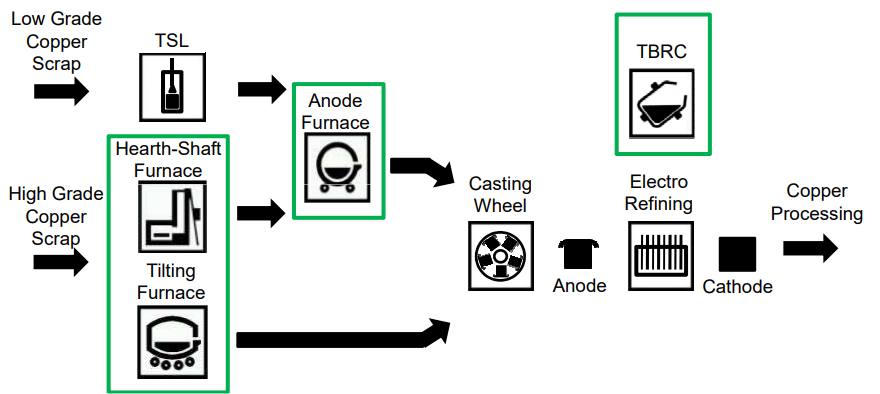
Figure 23‑2. Generalised flow chart for processing copper scrap1
Table 23‑1: Pyrometallurgical processes used to recover copper and other metals from copper waste1
|
Process |
Technology |
Location |
Feed Materials |
Metals recovered |
Process summary |
|
TSL |
Outotec Ausmelt |
Dowa Mining Co. Ltd. Kosaka Copper Smelter Akita, Japan |
E-waste Cu residues |
Cu, Ni, Ag, Au, PGMs, Pb, Zn, Sb, Sn |
Multi-stage batch smelting and reduction operation to produce raw Cu and recover Pb, Zn and other metal values. |
|
Outotec Ausmelt |
Global Resources & Materials (GRM) Danyang, Korea |
E-waste Cu residues |
Cu, Ni, Ag, Au, PGMs, Pb, Zn |
Continuous smelting under reducing conditions to produce a ‘black copper’ product treated in downstream operations. |
|
|
Xstrata ISASMELT® |
Umicore Precious Metals Hoboken, Belgium |
E-waste Cu residues Industrial waste |
Cu, Ni, Ag, Au, PGMs, Pb, Sb, Sn, Bi, Se, Te, In |
Batch smelting and converting to produce blister Cu. Part of the overall Base Metal and Precious Metal Operations Flowsheets. |
|
|
Xstrata ISASMELT® |
Aurubis Lünen, Germany |
Cu scrap Cu Residues |
Cu, Pb, Sn, Zn, |
Batch smelting (reductive) to ‘black Cu’ and converting to produce raw Cu. Part of the overall Kayser Recycling System (KRS). |
|
|
TBRC |
Outotec Kaldo |
Boliden Rönnskår Smelter Rönnskår, Sweden |
E-waste |
Cu, Ni, Ag, Au, PGMs, Se, Te |
Batch converting of e-waste to produce a mixed Cu alloy treated in downstream converting operations. |
|
Metallo Chimique N.V. Beerse, Belgium |
‘Black copper’ |
Cu, Ni, Pb, Sn |
Processing of ‘black copper’ sourced from external operations. |
||
|
Noranda Process |
Horne Smelter Quebec, Canada |
E-waste Cu concentrate |
Cu, Ni, Ag, Au, PGMs, Se, Te |
Continuous smelting of primary and secondary feeds to produce Cu matte treated in downstream converters. |
Top submerged lancing (TSL) furnace
TSL is a versatile bath smelting system, which will treat many types of feed material. Of particular interest to the metallurgical industry is the system’s ability to treat complex, multi-component materials1, for example electronic waste.
Tilting and other fire refining furnaces
The conventional fire refining process consists of an anode furnace capable of treating blister to anode copper through oxidation by air and reduction by reductant e.g., natural gas, LPG or diesel. These principles of fire refining have been modified by various companies who have developed fire refining furnaces that have been optimised for scrap processing. These include Tiling Refining and Elliptical Refining furnaces developed by SMS group, GmbH.1
Tilting refining furnaces are based on an improved scrap charging system and optionally semi-automatic skimming that keeps the operators at a safe distance from the molten metal. They are designed for the melting, refining and casting of copper scrap in one flexible unit. The copper scrap is charged in the form of bales or loose scrap via the charging doors or injected as fines. It is also possible to charge liquid material via launders from recycling of lower grade material in a TBRC (Top Blown Rotary Converter).
A small fire refining furnace, from the SMS group, which can process 30 metric tons of copper scrap per day will cost between €4-5 million ($4.5-6 million).2
Induction furnaces
Induction furnaces are normally used for the melting of copper, due to its higher melting temperature of 1083°C (1981°F). Double push-up furnaces are recommended when prototyping or for small-scale production. This is likely to be relevant for Oman’s use case based on the fact that the amount of copper scrap that is available is in relatively small quantities.
Double push-up furnaces use the approach of single-shot melting. Single shot melting rapidly melts enough metal for only one shot, and then the melting process is repeated for the next shot. The obvious advantage of this approach is that the melting process can be rapidly started or stopped, providing flexibility when only producing a limited number of rotors.1
Bioleaching of copper
Low grade copper scrap can potentially be subjected to bioleaching to extract copper and other valuable metals. Brain Biotech based in Germany has developed the BioXtractor, which uses proprietary microorganisms for the extraction of valuable metals from secondary raw materials. Depending on the metal to be extracted, specific microorganisms are used, which act on the secondary raw materials and extract precious metals with a yield of up to 100% of the metal. BRAIN owns intellectual property rights for the bacteria and the processes used and has successfully transferred the technology from laboratory to pilot scale. 1
Technologies for end-product manufacturing
Following copper scrap refining, the purified copper can be processed into rods, tubes or other end products as described in the previous section.
La Farga’s GENIUS copper rod from 100% recycled copper
La Farga is a privately held Spanish company specialising in semi- finished products. The company has three production plants in Spain, one in China and one in the US, as well as a copper pipe distribution centre in France. La Farga has a developed and patented a process called Cosmelt® for refining copper from recycled raw materials. Using this process, they created a copper rod continuous casting line for their product “GENIUS”, made from 100% recycled copper (Figure 23‑3). Application of GENIUS is for copper wire drawing, welding wire, twisted pair cabling and cabling in sectors of construction, infrastructure, industry, oil & gas, electricity networks and telecommunications. The company claims 72% reduction in CO2 emissions compared to International Copper Association’s study on electrolytic copper. Recycling companies in Oman should explore potential collaboration with La Farga.
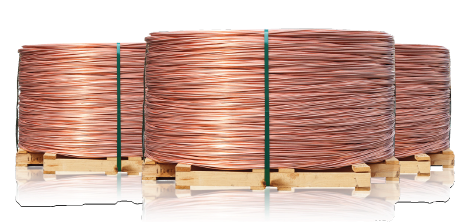
Figure 23‑3. GENIUS copper rod from 100% recycled copper.
Rod plants1
The SMS group has a modular rod plant system called compacROD®, which they claim to be a cost-effective solution for the production of copper wire rod in volumes of around 30,000 to 50,000 tons per year. The system uses the latest melting and rolling technology combined with a demand-oriented casting system. One compacROD plant can potentially meet all the copper rod demand of Oman’s wire and cable industry.
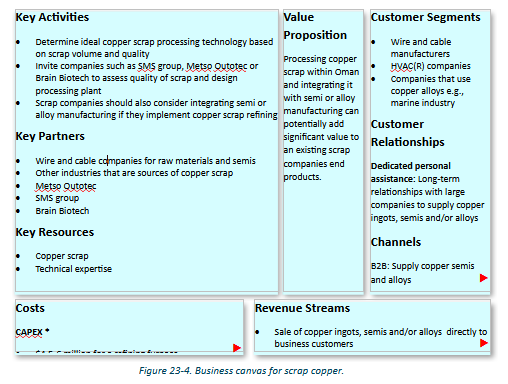
Business canvas for scrap copper
Figure 23-4 shows the business canvas for scrap copper. Future mining operations in Oman mean that there is the opportunity to process copper ore and sell higher value copper cathode both within the country and export abroad.
Next steps
Invite companies such as SMS group, Metso Outotec, Brain Biotech and La Farga to determine quality of scrap and assess the feasibility of a processing plant in Oman. The feasibility of a processing plant will also depend on the volume of scrap that is available to be processed.