
Pilot-scale, commercial and government-funded projects
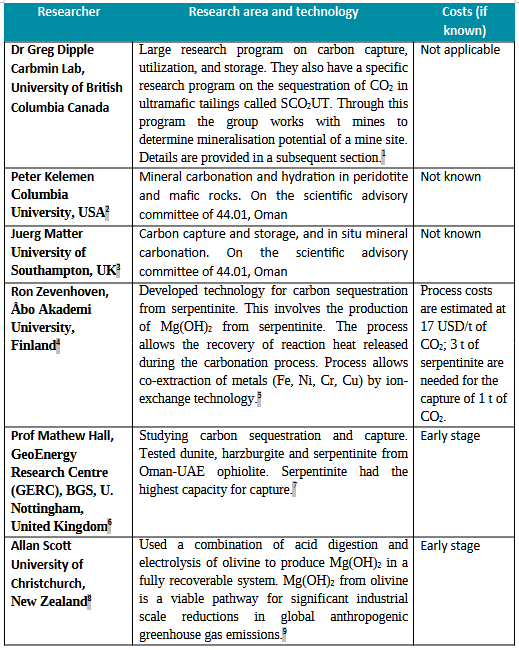
A selection of companies and government-funded projects that use carbon mineralisation for CO2 sequestration are shown in Table 27‑3. 44.01, an Omani company, plans to use in situ mineralisation where carbonated water is pumped into peridotite rock formations. Methods that make use of mine tailings and waste streams, which are more relevant to the mining industry, are being tested by Dr Greg Dipple’s SCO2UT project. This is discussed in detail in the next section.
Table 27‑3: Projects using carbon mineralisation for CO2 sequestration
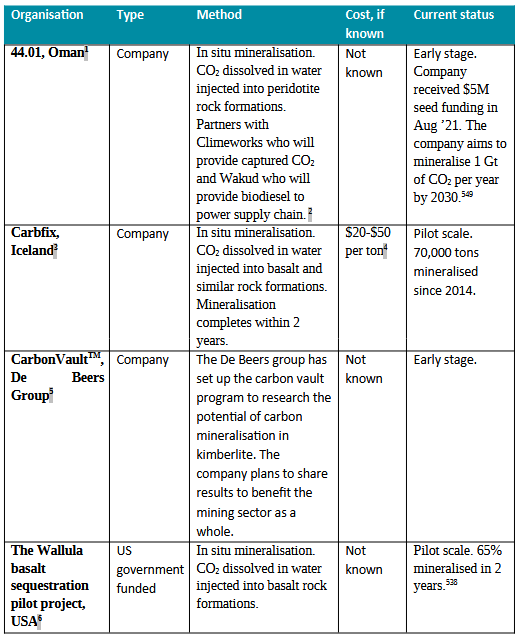
SCO2UT research program
SCO2UT research program from the Carbmin Lab (Dr Greg Dipple), University of British Columbia, Canada aims to sequester CO2 in mine waste from ultramafic tailings. The program determines the carbon mineralization potential of a mine site, and then implements strategies and technologies to maximize carbon uptake using mine waste. They focus on two types of ultramafic rocks: kimberlite and serpentinite. Projects include:
Gahcho Kué Diamond Mine (NWT, Canada)
Gahcho Kué is a diamond mine located in the Northwest Territories, Canada, owned and operated by De Beers Canada. It is the site of the first ever enhanced carbon mineralization field pilot at an active mine site, conducted in 2019 by CarbMin researchers.
Two experiments were conducted at Gahcho Kué in 2019:
-
In the first experiment, CO2 gas was injected into a six meter-long kimberlite tailings pipe. CO2 concentration measurements were taken at the beginning, middle, and end of the pipe. CO2 concentrations were lower at the middle and end of the pipe, demonstrating CO2 had been trapped by the kimberlite waste rock throughout the pipe.
-
The second experiment involved injecting CO2 gas into a cubic meter of kimberlite waste rock that was strategically compiled with layers of fine, coarse, and a mixture of fine and coarse waste rock materials. In this experiment, reactivity of the different layers was assessed and the manipulation of fine and coarse layers was tested to determine the perfect mix for trapping CO2.
A second field demonstration at larger scale was scheduled at Gahcho Kué for 2020 but was postponed due the Covid-19 pandemic.
Decar Nickel District (BC, Canada)
The Decar Nickel District is a greenfield nickel discovery, a promising target for nickel mining owned by FPX Nickel Corp. As an undeveloped deposit in serpentinite host rock, a mine here would have the opportunity to incorporate carbon mineralization strategies directly into its infrastructure and management plans from the beginning, rather than retrofitting to an active mine site. Decar hosts a nickel-iron alloy, called awaruite, and the district contains very low levels of potentially polluting and oxygen-reactive sulphide minerals. The low sulphide levels, combined with the host rock’s CO2 sequestration potential, make it well suited for atmospheric CO2 capture.
The CarbMin Lab works with FPX to assess the co-occurrence awaruite and reactive minerals that would enhance carbon mineralization. A field pilot was conducted in the summer of 2020 using host rock material from the Baptiste deposit, a locale within the Decar Nickel District, to determine the reactivity of potential mine tailings at this site. The experiment used several hundred kilograms of crushed serpentinized rock, divided into sections that were manipulated to determine the effects of different variables such as rainfall on the carbon uptake of the material.
Turnagain Nickel property (BC, Canada)
The Turnagain Nickel Property hosts a significant nickel resource. The property is owned by GigaMetals Corporation, who are collaborating with the CarbMin Lab to determine the carbon mineralization opportunity of the ultramafic host rock. Detailed geological mapping and exploration geophysical surveys have been conducted at this site due to its history of exploration, and researchers are currently conducting mineralogical studies to understand the distribution of relevant minerals within Giga’s Turnagain deposit. A future field experiment is planned to assess the carbon mineralization potential of Turnagain ultramafic material.
De Beers Diamond Mines (South Africa)
The CarbMin Lab is partnering with the De Beers Group to conduct research at several South Africa mines, including Venetia Diamond Mine, Cullinan Diamond Mine, and Voorspoed Diamond Mine, as part of the De Beers CarbonVaultTM program. CarbMin researchers examine the heterogeneity of kimberlite deposits to determine where the most reactive (for carbon mineralization) material is found, develop analytical methodology for measuring reactive material content within kimberlite waste samples, conduct experiments on mine-specific kimberlite waste rock, and overall work to lay the groundwork for large-scale utilization of carbon mineralization to sequester CO2 at De Beers mines.
Business canvas for carbon sequestration
Figure 14‑4 summarises the business opportunity for carbon sequestration. Although 44.01 is developing carbon sequestration and storage technology, the company plans to do this in situ, by pumping carbonated water underground. Hence, there is an opportunity for a new company to utilise mining waste streams for carbon capture and sequestration. Furthermore, depending on the method used, valuable minerals can also be extracted, and sulphuric acid and/or CO2 for industrial use can be additional revenue streams. This makes a good case for another carbon capture and sequestration company to be established in Oman.
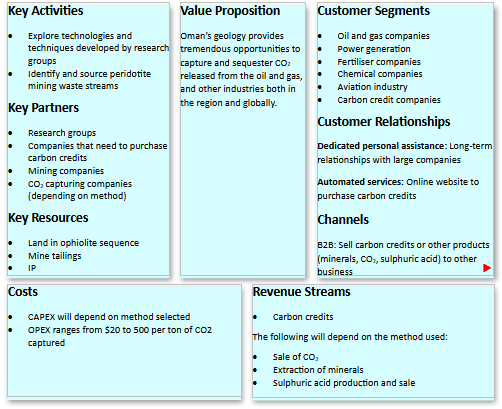
Figure-9: Business canvas for carbon sequestration
Next steps: Carbon Sequestration
-
Identify technology and IP for acquisition and/or relevant expert for collaboration, for example Dr Greg Dipple’s SCO2UT research program.
-
Determine total volume of tailings available for exploitation.
-
Undertake detailed assessment of technical and commercial feasibility.
-
Identify potential partners such as mining companies, companies that need to purchase carbon credits and CO2 capturing companies (depending on method).
-
Prepare business plan.
-
Seek funding.