
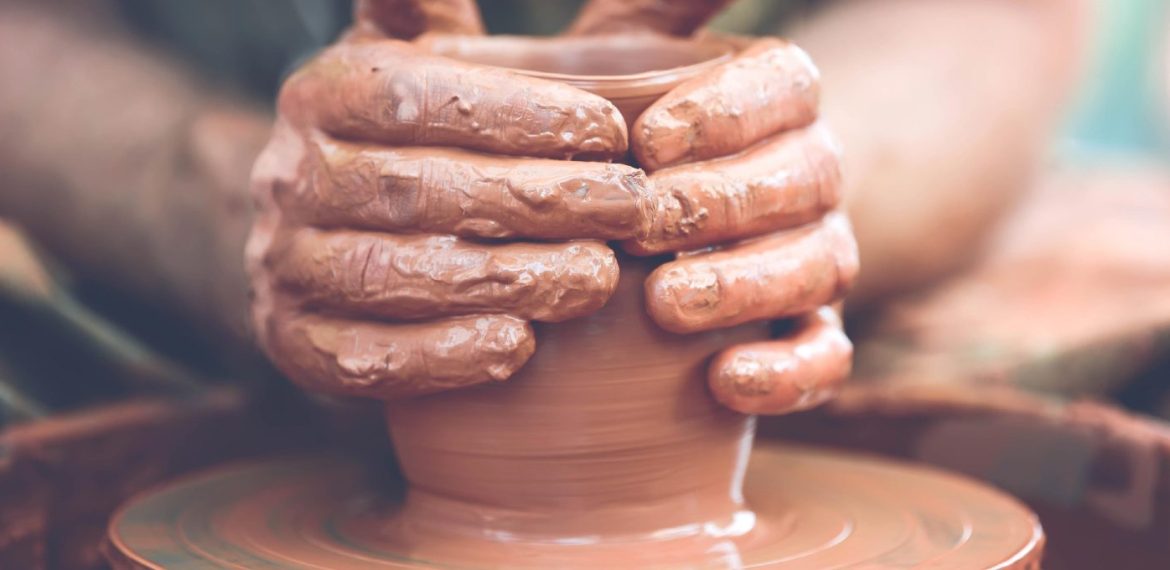
This Wikipedia is a dedicated knowledge base for the Clay Sector in the Sultanate of Oman.
Section Contents:
This website is comprised of two main sections:
- Clay Sector Overview – Overview of the global clay sector and the current situation in Oman
- Introduction
- Local Overview
- Global Overview
- Clay Sector Opportunities – Specific opportunities for innovation that were identified within the programme
- Introduction
- List of Opportunities
Clay Sector Overview
This section of the wiki gives an insight into the global clay industry and where Oman sits within that. Presented are the results of the initial scouting and benchmarking activities.
Introduction
1.1.1 Definitions
Clay occurs naturally on earth as a result of the mechanical and chemical breakdown of rocks[1]. It can be defined as a fine-grained material with a particle size greater than 2 μm. Clay is considered as a part of a group of crystalline hydrous silicate minerals known as clay minerals. These minerals consist mainly of silica, alumina, and water. They may also contain a significant amount of iron, alkalis, and alkaline earth.
Local Overview
Oman has a significant amount of clay resources in commercial quantities with the potential of creating jobs and market opportunities for both foreign and local industries. The abundance of ball clay, fire clay, bentonite, Fuller’s earth and brick clay, cement clay, china clay and kaolin clay in Oman mountains positions the country as a potential one-stop destination for clay exploration, marketing and business within the Gulf region. However, the industrial based for clay production and exploration are mostly lacking. There are small to medium scale industries currently exploring clay for fired and unfired bricks, cement, ceramic tiles and pottery.
1.2.1 Major Clay Types and Activities in Oman
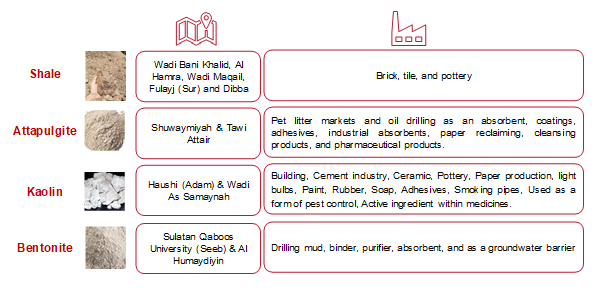
Although the country is endowed with a significant deposit of clay minerals, it is still in the early stages of exploitations as many reserves remain untapped. Four major types of clay, as shown in the Table below, have been identified and mined in Oman. The following gives a brief description about each type and its potential use.
Shale/Clay
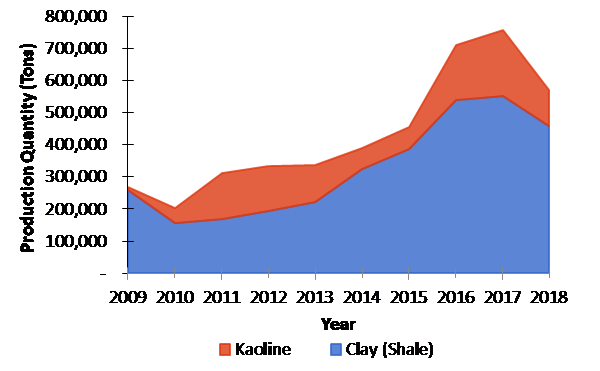
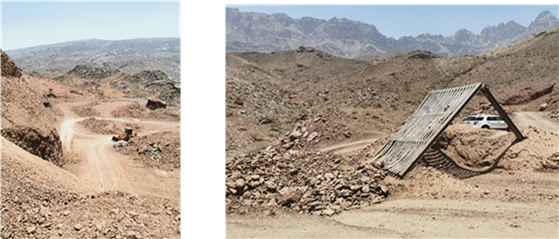
Shale clay deposits are very common in Oman. It is mined predominantly because of its high aluminum content which is needed by the cement industry and can be used to produce light weight and expanded clay aggregates. In Oman, shale is used by Oman Cement Company and Raysut Cement Company as a source of Aluminum. Shale clay is also widely used by the local ceramic industries because of its abundance. The large quarries in Wadi Bani Khaled and Burkat Al-Mouze are utilized by these companies. This type of clay is also used by some traditional pottery factories in Bahla using local small mine located close to their factories. The production of Shale clay has been relatively unstable over the years but achieved a significant peak of 550,749 tonnes in 2017 before it dropped to 459,587 tonnes in 2018 (Figure 4).
Kaolin
Kaolin is the classic ceramic clay discovered in ancient China and had been used extensively over the centuries for the production of fine ceramics. It is generally a white or light-coloured soft clay mineral, which is often created through prolonged weathering of shales or granites to form extensive deposits. In addition to its traditional use, kaolin is now used as a white filler for pigments, papers and plastics.
The Hawshi deposit, which is 10-km west of Saiwan, is easily accessed by a graded road from the Qarn Al Alam to Saiwan. Here, a gently dipping seam of 4meter-thick medium-quality kaolin is mined primarily for use as aluminium-rich feed to the cement industry in Raysut near Salalah. Higher-quality grades are however suitable for use in the ceramic industry. Production of the Hawshi kaolin mine is reported to be 100,000 tonnes per annum. The mine is estimated to have at least a million ton of near-surface reserves. On the other hand, smaller deposits of similar quality kaolin are known elsewhere in the Huqf syncline, such as Wadi Sumaynah near Al- Duqm.
Attapulgite
Attapulgite, also known as Palygorskite or fullers earth, is magnesium-aluminium clay mineral with needle shaped crystals and possess a significant adsorption ability. Attapulgite eagerly adsorbs large quantities of several liquids such as water, oil, fats, dyes, chemicals and urine. These characteristics make attapulgite a unique technical material for many purposes such as pet litter, oil adsorbents, acid neutralizer, paper coating, medicinal uses and others. Attapulgite also displays the ability of gelling, which makes it an ideal and much demanded stabilizer for oil drilling muds. There have been several reports of attapulgite occurrences in many places in Oman but two well-known explored areas for their deposits are located in Tawi Attair and Shuwaymiyah in the Samhan mountain range.
The quantity of Attapulgite reserves at Tawi Attair is however low as it is estimated to be only 60% or 0.2 to 1 million tonnes. On the contrary, Shuwaymiyah deposit is much larger with an estimated reserve of more than 300 million tonnes of high quality attapulgite. Although these two sites boast of a significant reserve, none of them has been developed or exploited so far despite encouraging test results. The deposits sites are easily accessible from Tawi Attair, located 5 kilometres east of the village along the tarmac road.
Bentonite
Bentonite is the term applied to swelling clays with a large inner surface. Bentonites typically display thixotropic properties. That’s rapid temporary liquification under stress or agitation. It re-settles and changes back to solid mass after a period of time. These specific characteristics of bentonites are used for a variety of different technical applications such as drilling muds in the petroleum industry and sealing systems in the building industry. It is also used in ceramics and cosmetics due to its plasticizing ability and adsorption potential.
One of the two known places of bentonite reserves in Oman is at Sultan Qaboos University. The university occupies a greater land share of the deposit area. The other bentonite deposit site is located at Al Humaydiyin between Izki and Sinaw. Initial tests conducted at this site, Modern Salt Industries, proved promising with potential economical exploitation. Its favourable location and proximity to the Al Rusayl industrial area (90 kilometres) offers easy accessibility. Further detail studies are being conducted at this deposit site by the company.
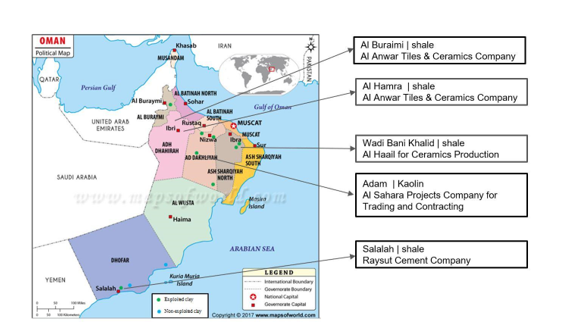
Although there are many clay mineral deposits in the country, they are currently being exploited mainly by local industries as well as small individual groups. This leaves room for further exploitation to maximize the full potential and develop market opportunities for the local clay industry.
1.2.2 Clay Mineral Production
The production of clay minerals in Oman has been increasing and improving relatively over the years from an annual output of over 200,000 tons in 2010 to about 750,000 tons in 2017. However, a decline in production by more than 30% was observed in the year 2018. The figure below demonstrates the progress of clay mineral production in Oman over the years.
1.2.3 Market Overview
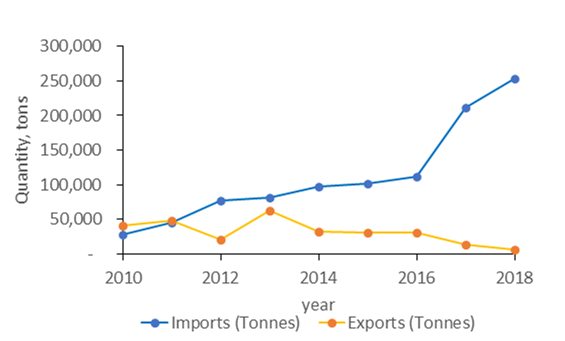
Although Oman is blessed with abundance of clay in its vast mountains, significant amounts of clays are also imported into the country for multiple purposes. The below figure clearly presents the trends from 2010 to 2018 on the quantities of clay imported and exported. Oman is importing kaolin, bentonite and some other types of clays form different countries. The imported clay has consistently been increasing over the years from less than 30 thousand tons in 2010 to about 250 thousand tons in 2018. The imported value of clay can be as low as OMR 10 per ton for some Indian kaolin and as high as OMR 2300 per ton for special bentonite clay.
1.2.4 Oman Downstream Industries
Clay in Oman is used in for different applications and for different downstream industries. The discussion below illustrates examples of the current applications and usage
Ceramic and Pottery Industry
Clay is used in Oman to manufacture ceramics tiles and sanitaryware. Al Anwar Tiles & Ceramics Company and Al Hail for Ceramics Production are specialized in ceramic tiles. Al Anwar Tiles & Ceramics Company is a small-scale mining company located in Al Hammra and produced around 140 tons of ceramics per day. The largest non-tile ceramic producer in Oman is the Oman Ceramics Company SAOG(OCC) in Sohar. Their 53,000 sq meter factory was set up in 1999 to produce high quality sanitaryware.
1.2.5 Building Materials
Kaolin is used to produce cement by Oman Cement Company (OCC) and Raysut Cement Company. A major part of the kaolin used by OCC is imported. Local clay is also used to produce Sarooj. Sarooj is a type of artificial pozzolan that has been widely used in Oman and the surrounding region for thousands of years. Sarooj has been used as a hydraulic binder in various applications including mortar, render, and the construction of the Aflaj system in Oman. The ‘recipe’ for Sarooj consists of clay, lime, sand, and water. These materials are mixed and calcined at high temperatures to increase the reactivity of the final binder.
For more information:
Bleaching Earth Industry
Bleaching earth is a term used to refer to several forms of clay that can be used for the refining of oils. For this application, we use the term bleaching earth to refer to activated bentonite clay. There are major edible oil producers in Oman; Areej Vegetable Oils & Derivatives SAOC and Omani Vegetable Oils & Derivatives Co. Oman currently imports around 3,000 tonnes of bleaching earth (activated bentonite) per year for use by edible oil manufacturing. Currently there are no companies producing activated bleaching earth for the edible oil refining industry in Oman, with most the bleaching earth being imported from a supplier in India called Ashapura Group[3] (Bhuj, India) at a cost of OMR 166 per ton.
For more information:
Cosmetic Industry
There are number of existing cosmetic companies in Oman that use or intended to use clay in their products. Unfortunately, all clay raw materials for the cosmetic industry in Oman are imported. Oliban company, for example, uses a clay type from Thailand for of main products: toothpaste and facial mask (Figure 9). Oliban has shown interest in assessing the possibility of using Omani clay instead of Thai clay for future production.
For more information:
Oil Industry
Clay (bentonite) is used as drilling fluid by the oil industry. Oman Drilling Mud Products Co LLC (ODMP) is currently manufacturing oilfield drilling chemicals. ODMP imports the raw materials from India and Morocco which are crushed and ground near the Salalah seaport as per the customer specifications. Most of their products are consumed locally by oil companies such as PDO, Halliburton and Abraj Energy. As with the bleaching earth, it is believed that Oman has sufficient bentonite deposits that can be used to manufacture oilfield drilling chemicals.
Global Overview
1.3.1 Markets
This section presents an industry overview of the natural stone sector, followed by more specific information regarding the clay sector specifically.
Kaolin
The main bulk applications of kaolin include paper, ceramics, paint and coatings. There are a range of low volume but high value applications for kaolin including pharmaceutical, cosmetics and functional fillers for various materials, as shown below. The typical wholesale prices for kaolin are OMR 53-62 per ton[4].
For more information:
Bentonite
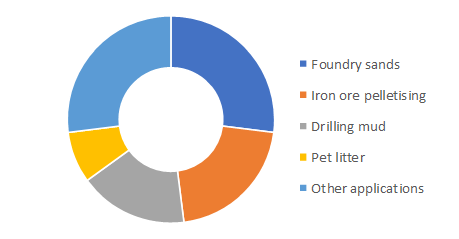
The main bulk applications of bentonite are foundry sands, iron ore pelletising, drilling mud and pet litter as illustrated below. The global bentonite market is estimated US$ 1.7 billion in 2019, with an annual growth rate of 6%. The typical price for bentonite is OMR 25-30 per tonne.
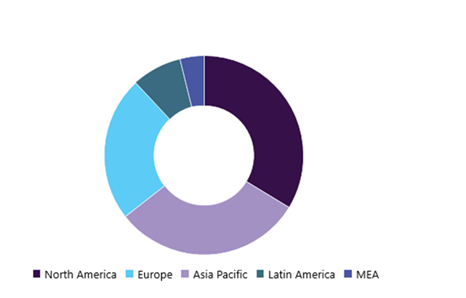
Major exporters of bentonite include China, India, Turkey and the USA. The largest market is the USA, which accounts for around 36% of global consumption of bentonite. Major importers include Japan, Germany, Canada, Brazil and the Netherlands.
Attapulgite
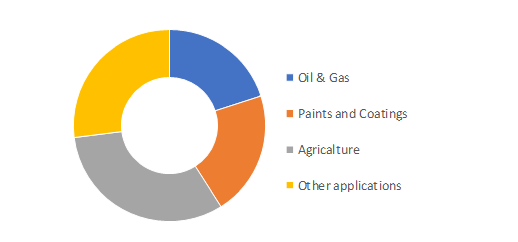
The main bulk applications of attapulgite, as presented in Figure 18, are in oil and gas, paints and coatings and agriculture. The global attapulgite market maintained an average annual growth of 4.86% from 2014 to 2019. The market size is valued at US$ 327.8 million in 2019.
1.3.2 Value chain structure
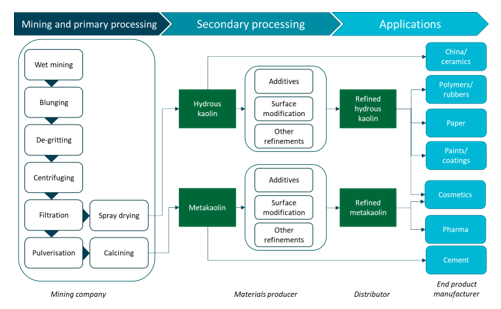
The value chain structure for clay and clay-based products was investigated. The below figure represents the key processes and typical value chain structure for kaolin-based products
1.3.3 Technology trends and innovations
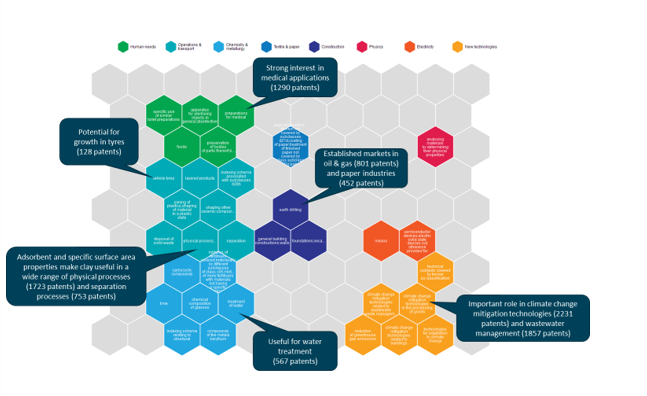
Patent analysis was used to identify trends in clay technology patent activity. The highlights are:
- Strong growth in clay technology patent activity in last 10 years
- China (10,673 patents) and USA (6,589 patents) are the biggest developers of clay technology based on patent activity.
- Key fields for patent activity include: medical, climate change mitigation technologies, wastewater management, physical processes and separation technologies, oil and gas, and paper.
- Whilst the number of patents for in the tyre industry was low (128 patents), several experts considered this to be an interesting area for the development of new intellectual property.
1.3.4 Examples of Innovations in clay technology
3D Printing for Pottery and Ceramics:
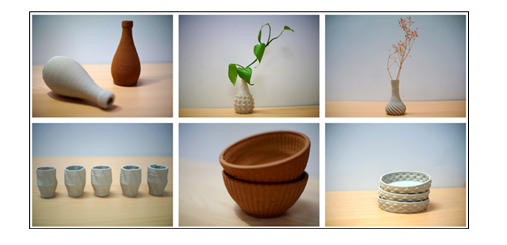
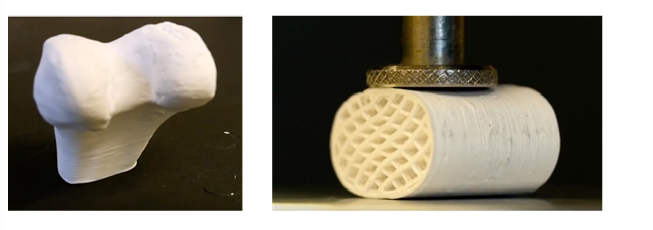
3D printing can be used currently for ceramic ornaments and pottery. Despite the capabilities of ceramic 3D printing to make complex and unique designs, major part of such type of 3D printing is used primarily for artistic purposes. Robocasting (filament and extruder) for ceramics was developed in the 1990s and various processes are being developed for printing of more technical ceramics. For example, 3D printing is used to obtain hyper-elastic and flexible ceramic bones.
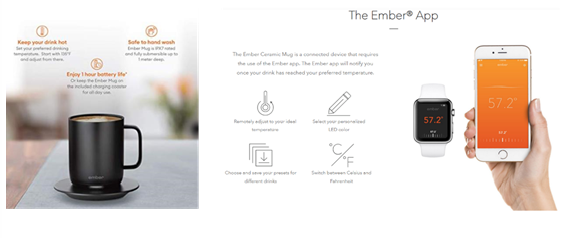
Ember – Smart coffee cup [12] :
Ember (USA) have launched a smart coffee cup with integrated heating element that keeps your hot beverage at the perfect temperature. As illustrated below, the cup can be connected to mobile app to show current temperature or to specify the preferred temperature for each type of drink.
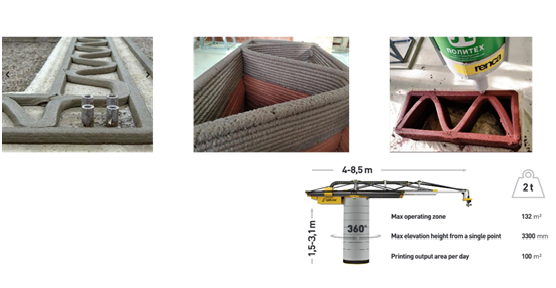
3D printing of geopolymer concrete: [13]
Renca (Russia) have developed a geopolymer concrete that can be used by 3D printers. The geopolymer was used to print walls of a 100 m2 house in 24 hours. The geopolymer has a compressive strength of 100 MPa. They claimed that this innovative geopolymer has a better fire and chemical resistance, superior waterproofness and fast curing.
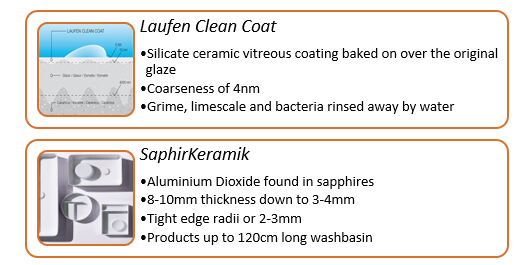
Innovation in sanitaryware:
Laufen (Switzerland) have developed two innovations as shown in the figure below for the sanitaryware market
Pottery and Ceramics: Counter travel kiln:
Keller (Germany) has developed a prototype counter travel kiln. The tunnel kilns try to minimise heat losses by having flue gases directed to the dryer. The counter travel kiln allows products entering the kiln from both sides. Heat from the cooling products is transferred directly to pre-heat the products entering the kiln. The manufacturer claimed that this technology can reduced the energy usage by 30%.
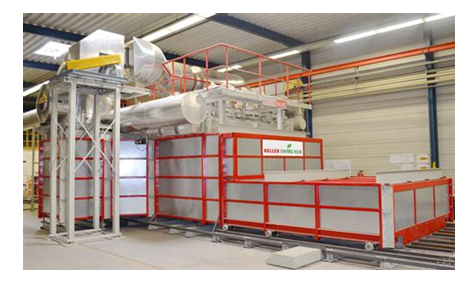
Figure 27: Keller Counter Travel Kiln for Ceramic and Pottery
Microwave assisted firing:
Several research teams are investigating microwave assisted gas firing technology[15]. This technology can induce significant energy savings. Danish Technological Institute (DTI) developed a prototype kiln for testing the potential of microwave assisted firing for the brick and tile industry. Other research teams are investigating the potential to use this technology for the pottery industry however they have encountered problems with temperature management.
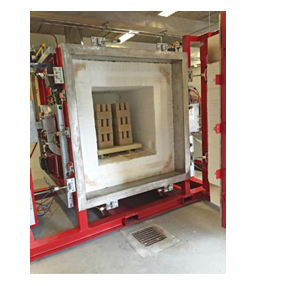
Figure 28: Microwave assisted gas kiln at DTI
1.3.5 Applications opportunities overview
The applications of the clay minerals are found in various industries such as building materials, ceramics and potteries, cosmetics, health & pharmaceutical, water treatment, refractory applications, edible oils and beverages, paint & coatings, pet care, agriculture, rubbers, polymers, papers, oil and gas, etc. The followings are brief description of potential applications in some of these industries:
Paint and paper industry:
Kaolin is largely used as a white pigment in paints and paper. However, the use of kaolin as a filler in paper has significantly decreased in the past 20 years because of a major change in the production of wood pulp from acid to alkaline process. This change has permitted a much more extensive use of calcium carbonate, which can survive an alkaline system[16].
For more information:
Rubber and plastic industry:
Kaolin is used as a functional filler for rubber and plastic (Figure 42). This includes nano-composites with polymers and rubber. Clays are one of the two types of nano-fillers that have been most widely discussed and the first to break into commercial use in nanocomposites (the second one is carbon nanotubes). Both fillers must be chemically modified with surface treatments in order to achieve the fine dispersion and resin coupling that are required to derive maximum benefit. The modification leads to the formation of clay particles with larger cavities[17].
For more information:
Ceramics and Pottery
Clay is used as a raw material for pottery and ceramic. There are many kaolin deposits that do not have the physical and chemical properties for paper coating but have very good ceramic properties. The ceramic use of kaolin continues to grow particularly in the tile and sanitaryware markets. The investigations of Oman kaolin have shown that it apparently fit best to this category due to high silica content[23].
Fiberglass
One other use of kaolin that has grown rapidly in the last 20 years is as a raw material in the production of fiberglass. The kaolin supplies both silica and alumina, which are needed in the fiberglass formulation. The kaolin for this application must have relatively low iron and titanium content. The reason for the increased use of fiberglass is because of the restricted use of asbestos due to health considerations.
Other applications
Lower-volume uses for kaolin include chemical manufacture (catalysts), civil engineering, agricultural applications, and pharmaceuticals. Improved processing techniques, which have evolved over the past 50 years, in particular have had a profound effect on the traditional and new applications of kaolin. Current high-tech developments in clay processing relay heavily on their chemical modification aimed at creation of a unique product with targeted applications[24].
Clay Sector Opportunities
Introduction
Identification & Evaluation of Opportunities
A combination of interviews with industry experts and potential suppliers, along with analysis of secondary data sources were used to explore industry trends, potential technologies and markets as shown in the figure below. 58 possibilities were identified from global scouting. These opportunities are evaluated for impact potential and shortlisted for further development through prototyping and feasibility analysis before some of the most promising ones will be selected for implementation through the Minerals Innovation Program while others will be floated as investment opportunities to local investors and business groups through the Central Innovation Hub for minerals and mining.
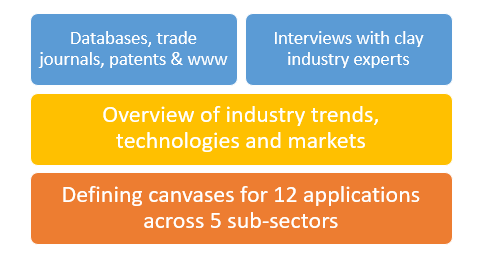
Figure 29
Summary of Evaluated Opportunities
From the 58 possibilities identified from Global Scouting conducted in clay business possibilities report, 12 were prioritized for further exploration and development. As shown in the figure below.
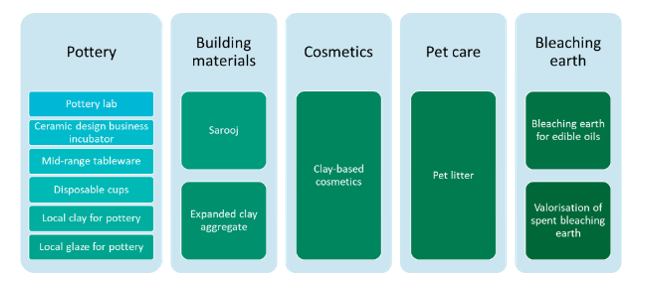
Figure 30: 12 ‘applications’ covered 5 sub-sectors
List of Opportunities
All 12 opportunities are listed below in their respective clusters. Click on each opportunity to find out more.
Sarooj for heritage applications
Expanded clay aggregate
Pottery and ceramic
Ceramic Design Business Incubator
Mid-range tableware
Disposable ceramic cup
Local clay for pottery and ‘one-stop shop’ for pottery supplies
Glaze production
Cosmetics
Pet Care
Bleaching earth
Valorisation of spent bleaching earth
Citations
Please note: These pages provide an introduction and overview of the nature of the selected opportunities. For more detailed information or to get involved with this opportunity, please contact Talal Al Wahaibi at the IIC: Talal.AlWahaibi@iic.om